GCSE Physics Tutorial: Drawing Distance-Time Graphs from Measurements
Distance-time graphs are powerful tools for visualizing the motion of objects and understanding how their positions change over time. To create a distance-time graph, you need accurate measurements of the distances an object covers at different points in time. In this tutorial, we'll guide you through the process of drawing distance-time graphs from measurements and interpreting the results.
Steps to Draw a Distance-Time Graph
Gather Data: Collect measurements of the distance an object travels at various points in time. Ensure your measurements are accurate and consistent.
Choose Axes: Draw the axes for your graph. The horizontal axis represents time (usually in seconds), and the vertical axis represents distance (usually in meters).
Plot Points: Plot each data point on the graph, with time on the horizontal axis and distance on the vertical axis. Make sure to label your axes with appropriate units.
Connect the Dots: Draw a smooth line connecting the plotted points. The line should accurately represent the general trend of the data points.
Interpret the Graph: Analyze the shape of the graph. Different slopes, curves, and patterns provide insights into the object's motion.
Example of Drawing a Distance-Time Graph
Let's consider an example where you have measured the distance traveled by a bicycle every 2 seconds:
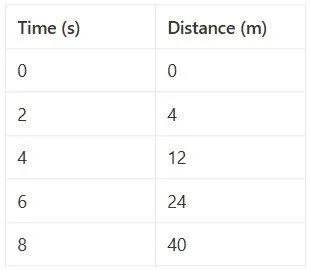
Draw the axes on a piece of graph paper, labeling them "Time (s)" for the horizontal axis and "Distance (m)" for the vertical axis.
Plot the points using the data from the table. For example, at time 2 seconds, plot a point at (2, 4), where 2 is the time and 4 is the distance.
Connect the plotted points with a smooth line that best represents the trend of the data.
Analyze the graph: In this case, the graph should show an upward-sloping line, indicating a consistent increase in distance over time. The steeper the slope, the faster the object is moving.
Summary
Drawing distance-time graphs from measurements is a fundamental skill in physics. By accurately plotting points and connecting them with a line, you create a visual representation of an object's motion. Interpreting the graph's shape, slope, and patterns can provide valuable insights into the object's speed, direction, and behaviour. Distance-time graphs help us analyze and describe motion in a clear and intuitive manner.
Looking for a more dynamic learning experience?
Explore our engaging video lessons and interactive animations that GoPhysics has to offer – your gateway to an immersive physics education!