GCSE Physics Tutorial: Identifying Changes in Velocity Due to Resultant Force in Real-World Scenarios
Understanding how changes in velocity occur due to resultant forces is essential for comprehending the dynamics of objects in motion. In the real world, various scenarios demonstrate how external forces can alter an object's velocity. In this tutorial, we'll explore common real-world scenarios where the velocity of an object changes due to resultant forces.
1. Acceleration of a Car:
When you press the accelerator pedal of a car, the engine produces a force that propels the car forward. This results in an acceleration that increases the car's velocity. The force from the engine overcomes any friction or air resistance that might oppose the motion.
2. Throwing a Ball:
When you throw a ball, your arm applies a force to it. This force causes the ball to accelerate and gain velocity in the direction of the throw. Gravity also influences the ball's downward motion, adding to its change in velocity.
3. Sliding on Ice:
If you push a sled on a slippery surface, like ice, the force you apply causes the sled to accelerate and increase its velocity. The lack of significant frictional forces allows the sled to maintain its motion with minimal deceleration.
4. Stopping a Moving Bike:
When you apply the brakes to a moving bicycle, the friction between the brake pads and the wheels generates a backward force. This force opposes the bike's forward motion, causing it to decelerate and eventually come to a stop.
5. Skydiving:
During skydiving, gravity acts as the dominant force. As you jump out of an airplane, gravity pulls you downward, accelerating you and increasing your velocity. When you open your parachute, air resistance (drag) becomes significant and opposes your downward motion, slowing your descent and decreasing your velocity.
6. Swinging on a Swing:
On a swing set, you push yourself backward to build up potential energy. As you let go, gravity pulls you downward, causing acceleration and an increase in velocity. At the bottom of the swing, you experience maximum velocity due to the combination of gravitational force and the potential energy you initially stored.
7. Rocket Launch:
During a rocket launch, powerful engines generate thrust by expelling gas at high speeds. This thrust creates a strong upward force that propels the rocket upward, overcoming Earth's gravitational pull. The rocket's velocity increases as a result.
Summary
In real-world scenarios, changes in velocity occur due to resultant forces that act on objects. Whether it's a car accelerating, a ball being thrown, a bicycle stopping, or any other situation involving motion, external forces play a significant role in altering an object's velocity. By understanding how forces influence velocity changes, you gain insights into the dynamics of motion in our everyday experiences and beyond.
Looking for a more dynamic learning experience?
Explore our engaging video lessons and interactive animations that GoPhysics has to offer – your gateway to an immersive physics education!
GCSE Physics Tutorial: Examples of Newton's First Law of Motion
Newton's First Law of Motion, also known as the law of inertia, states that objects at rest remain at rest, and objects in uniform motion continue moving with the same velocity unless acted upon by an external force. This law provides insight into the everyday behaviours of objects when no forces are present to influence their motion. In this tutorial, we'll recall and explore several examples that illustrate Newton's First Law in action.
1. Resting Objects
When you place a book on a table, it remains at rest until an external force is applied. This is an example of Newton's First Law in action. The book's inertia keeps it from moving until a force (like your hand) acts on it.
2. Moving Vehicles
A car traveling at a constant speed on a straight road will continue moving with the same velocity if no forces act on it. This is why you don't feel a sudden jolt when the car maintains a steady pace on a smooth road.
3. Sliding Objects
Imagine sliding a puck on an ice rink. Once you give the puck a push, it keeps moving until friction or another force slows it down. The puck's inertia allows it to maintain its motion even without the initial push.
4. Ball Rolling Down a Hill
When a ball is placed on a hill, it doesn't move until an external force (such as a push or gravitational force) acts on it. Once the ball starts rolling, it continues moving due to its inertia.
5. Opening Car Windows
When you're in a moving car and you open the window, the wind rushes in due to your car's motion. The air inside the car, including you, has inertia and tends to remain in its state of motion.
6. Stopping a Bicycle
When you apply the brakes on a bicycle, the friction between the brakes and the wheels causes the bicycle to decelerate and eventually stop. This demonstrates how external forces can counteract an object's inertia.
7. Objects in Space
In the vacuum of space, where there's minimal air resistance, objects continue moving at a constant velocity unless acted upon by external forces. This concept is crucial for understanding the motion of planets, satellites, and other celestial bodies.
Summary
Newton's First Law of Motion is evident in countless scenarios in our daily lives and in the broader universe. From objects at rest to those in motion, the law of inertia helps us understand how objects behave when no external forces are at play. These examples highlight the fundamental principle that objects tend to maintain their current state of motion or rest unless influenced by external factors.
Looking for a more dynamic learning experience?
Explore our engaging video lessons and interactive animations that GoPhysics has to offer – your gateway to an immersive physics education!
GCSE Physics Tutorial: Recall Newton's First Law of Motion
Newton's First Law of Motion, also known as the law of inertia, is a fundamental principle in physics that describes the behaviour of objects when no external forces act upon them. Understanding this law is essential for comprehending how objects move and behave in various situations. In this tutorial, we'll delve into the details of Newton's First Law and its significance.
Newton's First Law: The Law of Inertia
Newton's First Law of Motion: An object at rest will remain at rest, and an object in uniform motion will continue moving with the same velocity unless acted upon by an external force.
This law emphasises the concept of inertia, which is an object's tendency to resist changes in its state of motion. Inertia depends on an object's mass; objects with greater mass exhibit greater inertia.
Key Concepts of Newton's First Law
Inertia: Objects naturally maintain their current state of motion (or rest) unless a force is applied to change that state.
Equilibrium: An object is in equilibrium when the net force acting on it is zero. This can mean the object is at rest or moving with constant velocity.
Unbalanced Forces: If unbalanced forces act on an object, they will cause a change in its motion. Unbalanced forces result in acceleration, deceleration, or changes in direction.
Balanced Forces: When the net force on an object is zero, balanced forces are at play. In this case, the object remains in equilibrium or continues moving at a constant velocity.
Real-World Examples
Pushing a Car: A car at rest requires an external force (such as pushing) to overcome its inertia and set it in motion.
Sliding Objects: Objects on a frictionless surface will continue moving indefinitely once given a push, demonstrating inertia.
Application of Newton's First Law
Newton's First Law provides the foundation for understanding motion and forces. It's a starting point for explaining why objects behave the way they do in the absence of external influences. This law is integral to grasping subsequent laws of motion and the broader principles of physics.
Summary
Newton's First Law of Motion, or the law of inertia, asserts that objects maintain their state of rest or uniform motion unless acted upon by an external force. This law highlights the concept of inertia, which explains why objects tend to "resist" changes in their motion. Understanding this law is crucial for comprehending the behaviour of objects in the absence of external forces and is a fundamental building block of physics.
Looking for a more dynamic learning experience?
Explore our engaging video lessons and interactive animations that GoPhysics has to offer – your gateway to an immersive physics education!
GCSE Physics Tutorial: Interpreting Changes in Motion in Terms of Forces
Interpreting changes in motion involves understanding the forces acting on an object and how they influence its behaviour. Forces are fundamental to physics and play a crucial role in explaining how objects accelerate, decelerate, change direction, and come to rest. In this tutorial, we'll guide you through the process of interpreting changes in motion in terms of the forces at play.
Newton's First Law of Motion
Before we delve into interpreting changes in motion, let's revisit Newton's First Law of Motion, also known as the law of inertia. It states that an object will remain at rest or in uniform motion unless acted upon by an external force. This law sets the foundation for understanding how forces affect changes in motion.
Interpreting Changes in Motion
Starting Motion: When an object is at rest or moving at a constant velocity, the net force acting on it is zero. It's in equilibrium according to Newton's first law.
Acceleration: If an object's velocity changes, it's experiencing acceleration. This change can be due to an unbalanced force acting on it. A positive net force causes acceleration in the direction of the force, while a negative net force (opposite in direction to motion) causes deceleration or negative acceleration.
Change in Direction: When an object changes direction, it experiences a net force that acts perpendicular to its original velocity. This force is responsible for causing centripetal acceleration, keeping the object in circular motion.
Balanced and Unbalanced Forces: Balanced forces result in no change in motion. Unbalanced forces, on the other hand, cause a change in motion, whether in terms of speed, direction, or both.
Examples of Interpreting Motion Changes
Starting a Car: When you start a car from rest, the force applied by the engine overcomes inertia, resulting in acceleration.
Slowing Down: When you apply brakes to a moving bicycle, friction between the brake pads and the wheel slows the bike down due to the opposing force.
Curving in a Car: When you take a sharp turn in a car, the friction between the tires and the road provides the centripetal force that changes the car's direction.
Summary
Interpreting changes in motion involves recognising the influence of forces on an object's behaviour. Whether it's starting, accelerating, decelerating, or changing direction, forces play a pivotal role. Newton's First Law of Motion reminds us that objects tend to maintain their current state of motion unless acted upon by external forces. By understanding the forces at play, you can explain and predict the changes in motion observed in various situations.
Looking for a more dynamic learning experience?
Explore our engaging video lessons and interactive animations that GoPhysics has to offer – your gateway to an immersive physics education!
GCSE Physics Tutorial: Drawing and Interpreting Velocity-Time Graphs for Objects with Terminal Velocity
Velocity-time graphs offer valuable insights into an object's motion, including how it accelerates and reaches terminal velocity when moving through fluids. In this tutorial, we'll guide you through the process of drawing and interpreting velocity-time graphs for objects that reach terminal velocity.
Drawing Velocity-Time Graphs for Terminal Velocity
To draw a velocity-time graph for an object that reaches terminal velocity, follow these steps:
Initial Acceleration: At the beginning, the object accelerates due to gravity with a steep positive slope on the graph.
Increase in Drag: As the object gains speed, the drag force from the fluid increases, opposing its motion. The graph's slope gradually decreases.
Terminal Velocity: Eventually, the drag force becomes equal in magnitude to the gravitational force, resulting in a net force of zero. At this point, the graph levels off into a horizontal line, indicating constant velocity (terminal velocity).
Interpreting Velocity-Time Graphs for Terminal Velocity
When interpreting a velocity-time graph for an object that reaches terminal velocity:
Initial Acceleration: The steep positive slope at the beginning indicates that the object is accelerating due to gravity.
Decreasing Slope: The gradual decrease in slope represents a reduction in acceleration as the object encounters increasing drag forces.
Horizontal Line: The flat portion of the graph indicates that the object has reached terminal velocity. The velocity remains constant because the net force is zero.
Example Interpretation
Let's consider a velocity-time graph for an object falling through air. At first, the graph has a steep positive slope as the object accelerates due to gravity. As the object gains speed, the slope becomes less steep, indicating a decrease in acceleration due to increasing drag forces. Finally, the graph levels off into a horizontal line, showing that the object has reached terminal velocity.
Summary
Drawing and interpreting velocity-time graphs for objects that reach terminal velocity involves capturing the key stages of the object's motion. From initial acceleration to the gradual reduction in slope and the eventual flat line indicating terminal velocity, these graphs provide a visual representation of how objects respond to gravitational and resistive forces when moving through fluids. Understanding these graphs enhances our understanding of terminal velocity and the interplay of forces on falling objects.
Looking for a more dynamic learning experience?
Explore our engaging video lessons and interactive animations that GoPhysics has to offer – your gateway to an immersive physics education!
GCSE Physics Tutorial: Acceleration of Objects Falling Through Fluids and Terminal Velocity
When objects fall through fluids (such as air or water), their motion is influenced by a combination of forces, including gravity and resistive forces. Understanding this interaction is crucial in explaining why objects eventually reach a maximum speed known as terminal velocity. In this tutorial, we'll explore how objects accelerate when falling through fluids and how terminal velocity is reached.
Initial Acceleration
When an object is dropped from a certain height, it initially accelerates due to the force of gravity. This acceleration is commonly referred to as free fall. However, as the object gains speed, it encounters resistive forces from the fluid it's moving through. These resistive forces are collectively known as drag.
Resultant Forces
As the object accelerates downward due to gravity, the drag force opposes its motion. Initially, the force of gravity is greater than the drag force, causing the object to accelerate. This results in an increasing velocity.
Terminal Velocity
As the object's velocity increases, the drag force also increases. Eventually, a point is reached where the drag force becomes equal in magnitude to the force of gravity. At this point, the net force acting on the object becomes zero, resulting in a constant velocity known as terminal velocity.
Factors Affecting Terminal Velocity
The terminal velocity of an object falling through a fluid depends on several factors:
Mass and Shape: Objects with larger cross-sectional areas and greater mass will experience higher drag forces, leading to lower terminal velocities.
Fluid Density: Objects falling through denser fluids will experience higher drag forces, leading to lower terminal velocities.
Fluid Viscosity: Viscous fluids create greater drag forces, causing lower terminal velocities.
Gravitational Force: In environments with different gravitational fields (e.g., on the Moon), terminal velocity will be different due to the change in gravitational force.
Summary
When objects fall through fluids, they initially accelerate due to the force of gravity. However, as they gain speed, the drag force from the fluid increases, eventually balancing the force of gravity. This results in a constant velocity known as terminal velocity. Factors such as object mass, shape, fluid density, and fluid viscosity influence terminal velocity. Understanding these concepts helps us explain and predict the behaviour of objects falling through fluids and their ultimate maximum speeds.
Looking for a more dynamic learning experience?
Explore our engaging video lessons and interactive animations that GoPhysics has to offer – your gateway to an immersive physics education!
GCSE Physics Tutorial: Recording the Acceleration Due to Gravity on Earth
The acceleration due to gravity is a fundamental constant that determines how quickly objects fall toward the Earth's surface. It plays a crucial role in various aspects of physics and everyday life. In this tutorial, we'll explore how to record and understand the acceleration due to gravity on Earth.
Defining Acceleration Due to Gravity
Acceleration due to gravity (often denoted as "g") is the acceleration experienced by an object when it falls freely under the influence of Earth's gravity. It's the rate at which an object's velocity changes due to the force of gravity.
Magnitude of Acceleration Due to Gravity
On the surface of the Earth, the standard value of acceleration due to gravity is approximately 9.81 meters per second squared (m/s²). This means that every second, the velocity of an object in free fall increases by 9.81 meters per second. Keep in mind that this value can vary slightly depending on your location, altitude, and other factors.
Units of Acceleration Due to Gravity
Acceleration is measured in units of acceleration, which are meters per second squared (m/s²). This unit represents the change in velocity over time squared. The acceleration due to gravity is a specific instance of acceleration and has the same units.
Recording Acceleration Due to Gravity
To record the acceleration due to gravity on Earth, you can conduct a simple experiment using a pendulum. The period of a pendulum (time it takes to complete one swing back and forth) is related to the acceleration due to gravity. By measuring the period and using the appropriate formula, you can calculate the acceleration due to gravity for your location.
Example Calculation
Imagine you have a pendulum with a period of 2 seconds. Using the formula for the period of a simple pendulum, which is T = 2π√(L/g), where L is the length of the pendulum and g is the acceleration due to gravity, you can rearrange the formula to solve for g:
g = (4π² * L) / T²
If you measure the length of the pendulum to be 1 meter and the period to be 2 seconds, you can calculate the acceleration due to gravity:
g = (4 * π² * 1 m) / (2 s)² ≈ 9.87 m/s²
Summary
Recording the acceleration due to gravity on Earth is a fundamental aspect of understanding how objects fall and how forces act upon them. The standard value of approximately 9.81 m/s² is used in various physics calculations and provides insight into the behaviour of objects under gravity's influence. Conducting experiments and using formulas like those involving pendulums can help you record this important value for your location.
Looking for a more dynamic learning experience?
Explore our engaging video lessons and interactive animations that GoPhysics has to offer – your gateway to an immersive physics education!
GCSE Physics Tutorial: Calculating Acceleration Without Time
Acceleration is a fundamental concept in physics that quantifies how an object's velocity changes over time. While the standard formula for calculating acceleration involves time, there are scenarios where you can determine acceleration without directly knowing the time. In this tutorial, we'll explore how to calculate acceleration when time is not explicitly given.
The Standard Acceleration Formula
The standard formula for calculating acceleration (a) is:
Acceleration (a) = Change in Velocity (Δv) / Time Interval (Δt)
Where Δv is the change in velocity, and Δt is the time interval over which the change occurs.
Scenario: Acceleration Due to Gravity
In certain situations, you can calculate acceleration without knowing the exact time. One such scenario involves free fall near the surface of the Earth. When an object is in free fall, its acceleration is due to gravity and is approximately 9.81 m/s². In this case, you can calculate the acceleration without directly involving time.
Example Calculation
Suppose you drop an object from a certain height, and you want to calculate its acceleration due to gravity. Since the object is in free fall, the acceleration is approximately 9.81 m/s², regardless of the time it takes to reach the ground.
Summary
In most physics calculations, time is a crucial factor for determining acceleration. However, in specific scenarios like free fall near the Earth's surface, you can calculate acceleration without directly involving time. In such cases, the acceleration due to gravity remains constant and allows you to estimate the acceleration value without needing a specific time interval. Always remember that while this method is applicable in certain situations, the standard formula involving time is fundamental for calculating acceleration in a broader range of scenarios.
Looking for a more dynamic learning experience?
Explore our engaging video lessons and interactive animations that GoPhysics has to offer – your gateway to an immersive physics education!
GCSE Physics Tutorial: Measuring Area Under Velocity-Time Graphs Using the Counting the Squares Method
Velocity-time graphs offer insights into an object's motion, and measuring the area under the graph can provide valuable information about distance traveled or displacement. One method to estimate this area is the counting the squares method, which involves dividing the graph into squares and rectangles and then counting them to estimate the enclosed area. In this tutorial, we'll guide you through measuring the area under a velocity-time graph using the counting the squares method.
Steps to Measure Area Using Counting the Squares Method
Draw Gridlines: Draw horizontal and vertical gridlines on the graph paper to create squares or rectangles that cover the enclosed area.
Count the Squares: Count the number of complete squares and partial squares that are completely within the enclosed area.
Estimate Partial Squares: For squares that are only partially within the area, estimate the fraction that is covered by the graph curve. This can be done by visual estimation.
Calculate Total Area: Add up the areas of the complete squares and partial squares. To calculate the area of a partial square, multiply its fraction by the area of a full square.
Convert Area to Units: Since each square represents a specific unit (e.g., m²), multiply the total area by the appropriate conversion factor to get the area in the desired units (e.g., meters or kilometers).
Example Measurement
Let's consider a velocity-time graph with an enclosed area that resembles a triangle. On the graph paper, each square represents 2 m/s for velocity and 1 second for time. You count 15 complete squares and 6 partial squares. The fraction of each partial square covered by the graph curve is approximately 0.3.
Total Area = (15 complete squares + 6 partial squares * 0.3) * (2 m/s * 1 s) = 39 m²
The estimated area under the graph is 39 square meters.
Summary
The counting the squares method offers a simple way to estimate the area under a velocity-time graph, providing insights into distance traveled or displacement. By dividing the graph into squares and rectangles, counting complete and partial squares, and converting the counted area to units, you can make a rough estimation of the enclosed area. While this method might not be highly precise, it can give you a quick visual estimate of the graph's significance in terms of distance or displacement.
Looking for a more dynamic learning experience?
Explore our engaging video lessons and interactive animations that GoPhysics has to offer – your gateway to an immersive physics education!
GCSE Physics Tutorial: Drawing Velocity-Time Graphs
Velocity-time graphs are graphical representations that depict an object's velocity changes over time. These graphs provide valuable insights into an object's acceleration, deceleration, and constant velocity. In this tutorial, we'll guide you through the process of drawing velocity-time graphs and interpreting the information they convey.
Steps to Draw a Velocity-Time Graph
Gather Data: Collect data about an object's velocity at different points in time. You might obtain this data from experiments, observations, or calculations.
Choose Axes: Draw the axes for your graph. The horizontal axis represents time (usually in seconds), and the vertical axis represents velocity (usually in meters per second, m/s).
Plot Points: Plot each data point on the graph, with time on the horizontal axis and velocity on the vertical axis. Ensure you label your axes with the appropriate units.
Connect the Dots: Draw a smooth line connecting the plotted points. The line should accurately represent the general trend of the data points.
Interpret the Graph: Analyse the shape of the graph. Different slopes, horizontal lines, and curves provide insights into the object's motion.
Example of Drawing a Velocity-Time Graph
Suppose you have data about a car's velocity at different times:
Time (s) Velocity (m/s) 0 0 2 10 4 20 6 30 8 30
Draw the axes on a piece of graph paper, labeling them "Time (s)" for the horizontal axis and "Velocity (m/s)" for the vertical axis.
Plot the points using the data from the table. For instance, at time 2 seconds, plot a point at (2, 10), where 2 is the time and 10 is the velocity.
Connect the plotted points with a smooth line that best represents the trend of the data.
Analyse the graph: In this example, the graph should show a straight line with a positive slope, indicating constant positive acceleration. The car's velocity is increasing uniformly over time.
Summary
Drawing velocity-time graphs is a fundamental skill in physics that allows you to visually represent an object's changing velocity over time. By accurately plotting points and connecting them with a line, you create a clear picture of the object's acceleration, deceleration, or constant velocity. Interpreting the graph's shape, slope, and patterns helps us analyze how an object responds to forces and changes in motion.
Looking for a more dynamic learning experience?
Explore our engaging video lessons and interactive animations that GoPhysics has to offer – your gateway to an immersive physics education!
GCSE Physics Tutorial: Calculating Distance from the Area Under a Velocity-Time Graph
Velocity-time graphs provide valuable insights into an object's motion, allowing us to analyse changes in velocity over time. The area under a velocity-time graph represents the displacement or distance traveled by an object. In this tutorial, we'll guide you through the process of calculating the distance traveled by an object using the area under a velocity-time graph.
Relationship between Area and Distance
In a velocity-time graph, the area under the graph curve represents the distance or displacement traveled by the object. The magnitude of the area, regardless of its shape, provides valuable information about the object's motion.
Steps to Calculate Distance from Area
To calculate the distance traveled by an object from the area under a velocity-time graph, follow these steps:
Identify the Relevant Area: Identify the region of the graph that corresponds to the time interval for which you want to calculate the distance. This may involve one or multiple sections under the curve.
Find the Area: Calculate the area under the curve within the selected time interval. You can break down the shape into simpler geometric figures like triangles and rectangles to calculate their individual areas.
Interpret the Result: The calculated area represents the distance traveled by the object within the specified time interval.
Example Calculation
Let's consider a velocity-time graph with a triangular region under the curve. The base of the triangle corresponds to a time interval of 4 seconds, and the height represents a velocity of 10 m/s. To calculate the distance traveled:
Area of Triangle = 0.5 * Base * HeightArea = 0.5 * 4 s * 10 m/s = 20 m
The distance traveled by the object within that time interval is 20 meters.
Summary
Calculating the distance traveled by an object from the area under a velocity-time graph is a useful skill in physics. By identifying the relevant area, calculating the area using geometric shapes, and interpreting the result, you can determine the distance traveled by the object within a specific time interval. This method offers an intuitive way to analyse and quantify an object's motion based on the velocity-time graph.
Looking for a more dynamic learning experience?
Explore our engaging video lessons and interactive animations that GoPhysics has to offer – your gateway to an immersive physics education!
GCSE Physics Tutorial: Estimating the Magnitude of Everyday Accelerations
In our daily lives, we encounter a variety of situations where objects undergo acceleration, either due to changes in speed or direction. Understanding and estimating the magnitudes of these everyday accelerations can provide insights into the forces and motions that shape our experiences. In this tutorial, we'll explore how to estimate the magnitudes of common everyday accelerations.
Types of Everyday Accelerations
Everyday situations involve different types of accelerations:
Free Fall: When objects fall under the influence of gravity, they experience an acceleration of approximately 9.81 meters per second squared (m/s²), often denoted as "g."
Stopping a Vehicle: When a vehicle comes to a stop, it experiences deceleration, which can vary depending on the braking force and vehicle's mass.
Car Acceleration: When a car accelerates from a standstill, it can experience accelerations of a few m/s². On highways, cars may accelerate at around 2-3 m/s² to reach typical speeds.
Elevator: The sensation of weightlessness in an elevator moving upwards or downwards is due to accelerations caused by the elevator's changing velocity.
Swinging: On a swing, you experience acceleration as you move back and forth due to changes in direction.
Estimating Everyday Accelerations
To estimate the magnitudes of everyday accelerations, consider these steps:
Identify the Situation: Recognise the scenario involving acceleration. For example, falling objects, braking vehicles, or elevators.
Determine Time and Speed Changes: Estimate the time interval over which the acceleration occurs and the change in speed or velocity.
Use Basic Physics Equations: For free fall, you can use the acceleration due to gravity (g = 9.81 m/s²). For vehicles or elevators, you may need to calculate acceleration using a = Δv / Δt.
Consider Orders of Magnitude: Remember that these are rough estimates. You don't need precise calculations; order of magnitude approximations can provide useful insights.
Example Estimations
Free Fall: Estimate that objects fall at about 10 m/s² due to gravity.
Braking Car: If a car stops in 5 seconds from 30 m/s, the deceleration is roughly 6 m/s².
Car Acceleration: If a car takes 10 seconds to reach 100 km/h from rest, the acceleration is approximately 2.78 m/s².
Summary
Estimating the magnitudes of everyday accelerations allows us to understand the forces and motions that shape our experiences. By recognising the situations involving acceleration, estimating time and speed changes, and using basic physics concepts, you can gain a rough sense of how objects respond to changes in speed or direction. These estimations provide valuable insights into the physical world around us.
Looking for a more dynamic learning experience?
Explore our engaging video lessons and interactive animations that GoPhysics has to offer – your gateway to an immersive physics education!
GCSE Physics Tutorial: Calculating Acceleration from a Velocity-Time Graph
In physics, acceleration is the rate of change of an object's velocity with respect to time. Velocity-time graphs are graphical representations that provide insights into an object's motion. By analysing these graphs, you can calculate the acceleration of an object. This tutorial will guide you through the process of calculating acceleration from a velocity-time graph.
Understanding Velocity-Time Graphs:
A velocity-time graph (v-t graph) plots an object's velocity on the vertical axis and time on the horizontal axis. The slope of the graph represents the object's acceleration. Here are some key points to remember:
Flat Line: If the graph forms a horizontal line, the object is moving at a constant velocity. In this case, the acceleration is zero, as there is no change in velocity over time.
Steep Line: A steeper slope indicates a larger change in velocity over time, which means the object is accelerating. The steeper the line, the greater the acceleration.
Positive Slope: A positive slope (rising from left to right) represents positive acceleration. This means the object is speeding up in the positive direction.
Negative Slope: A negative slope (falling from left to right) indicates negative acceleration or deceleration. The object is slowing down in the positive direction.
Calculating Acceleration from a Velocity-Time Graph:
To calculate acceleration from a velocity-time graph, follow these steps:
Identify the Slope: Determine the section of the graph that represents the interval during which the acceleration is occurring. This is usually a curved or steep part of the graph.
Choose Two Points: Select two points on the chosen interval of the graph. These points should be easy to read accurately, preferably where the graph is well-defined. Note down the coordinates of these points as
(t₁, v₁)and(t₂, v₂).Calculate Change in Velocity: Find the change in velocity (
Δv) between the two selected points. This can be calculated using the formula:$\Delta v=v2-v1$
Calculate Time Interval: Determine the time interval (
Δt) between the two selected points. This can be calculated using the formula:$\Delta t=t2-t1$
Calculate Acceleration: Finally, use the following formula to calculate acceleration (
a):$a= \frac{ \Delta v}{ \Delta t}
Unit Consideration: Make sure to use consistent units for time and velocity to obtain the correct unit of acceleration (e.g., m/s²).
Example:
Let's consider a velocity-time graph with two points: A(2 s, 10 m/s) and B(6 s, 30 m/s).
Identify the Slope: The interval between points A and B represents acceleration.
Choose Two Points: A(2 s, 10 m/s) and B(6 s, 30 m/s).
Calculate Change in Velocity:
$ \Delta v = 30-10=20 \text{m/s}$
Calculate Time Interval:
$ \Delta t=6-2=4 \text{s}
Calculate Acceleration:
Therefore, the acceleration of the object during this interval is 5 m/s².
Summary:
Calculating acceleration from a velocity-time graph involves finding the change in velocity between two points and dividing it by the corresponding time interval. By understanding the principles of velocity-time graphs and following these steps, you can accurately determine an object's acceleration at specific points during its motion.
Looking for a more dynamic learning experience?
Explore our engaging video lessons and interactive animations that GoPhysics has to offer – your gateway to an immersive physics education!
GCSE Physics Tutorial: Calculating Acceleration
Acceleration is a fundamental concept in physics that describes the rate of change of an object's velocity. It quantifies how quickly an object's speed is changing over time. In this tutorial, we'll explore how to calculate acceleration and understand its significance in describing motion.
What is Acceleration?
Acceleration refers to the change in an object's velocity over time. Velocity is a vector quantity, so acceleration involves both changes in magnitude (speed) and direction. An object can accelerate if it's speeding up, slowing down, or changing direction.
Calculating Acceleration
Mathematically, acceleration (a) can be calculated using the following formula:
Acceleration (a) = Change in Velocity (Δv) / Time Interval (Δt)
Where:
Change in Velocity (Δv) is the difference between the final velocity and the initial velocity of the object.
Time Interval (Δt) is the duration over which the velocity change occurs.
Units of Acceleration
In the International System of Units (SI), acceleration is measured in meters per second squared (m/s²). This unit indicates that for every second that passes, the object's velocity changes by a certain amount.
Positive and Negative Acceleration
Positive Acceleration: If an object's velocity increases over time, it's experiencing positive acceleration. This is also known as "acceleration" in common language.
Negative Acceleration (Deceleration): If an object's velocity decreases over time, it's experiencing negative acceleration, often referred to as "deceleration." It's important to note that negative acceleration doesn't necessarily mean the object is slowing down; it can also indicate a change in direction.
Example Calculation
Let's consider a car that starts from rest and reaches a velocity of 20 m/s in 10 seconds. To calculate its acceleration:
Change in Velocity (Δv) = Final Velocity - Initial VelocityΔv = 20 m/s - 0 m/s = 20 m/s
Time Interval (Δt) = 10 s
Acceleration (a) = Δv / Δt = 20 m/s / 10 s = 2 m/s²
The car's acceleration is 2 meters per second squared.
Summary
Acceleration is a crucial concept in physics that describes how an object's velocity changes over time. It can be calculated using the formula a = Δv / Δt, where Δv is the change in velocity and Δt is the time interval. Positive acceleration indicates speeding up, negative acceleration (deceleration) indicates slowing down or changing direction, and acceleration is measured in meters per second squared (m/s²). Calculating acceleration helps us understand how objects respond to forces and how they undergo changes in motion.
Looking for a more dynamic learning experience?
Explore our engaging video lessons and interactive animations that GoPhysics has to offer – your gateway to an immersive physics education!
GCSE Physics Tutorial: Determining Speed from a Distance-Time Graph
Distance-time graphs offer a clear visual representation of an object's motion over time. By analysing the slope (gradient) of a distance-time graph, you can determine the speed of the object. In this tutorial, we'll guide you through the process of determining speed from a distance-time graph and understanding the relationship between the two.
Relationship between Gradient and Speed
In a distance-time graph, the gradient (slope) of the line represents the rate of change of distance with respect to time. Mathematically, the gradient is calculated as:
Gradient = Change in Distance / Change in Time
For an object moving at constant speed, the distance-time graph is a straight line. The gradient of this line is equal to the speed of the object.
Steps to Determine Speed from a Distance-Time Graph
To determine the speed of an object from a distance-time graph, follow these steps:
Identify a Straight Line Segment: Find a section of the graph where the object's motion is at a constant speed. This segment will be a straight line.
Select Two Points: Choose two points on the straight line segment. These points should be clearly defined on the graph, such as where the line intersects gridlines.
Calculate Change in Distance and Time: Determine the change in distance (vertical difference) and the change in time (horizontal difference) between the two selected points.
Calculate Speed: Divide the change in distance by the change in time to calculate the speed.
Example Calculation
Let's say you have a distance-time graph with a straight line segment between points A and B. The change in distance between A and B is 400 meters, and the change in time is 20 seconds. To determine the speed:
Gradient (Speed) = Change in Distance / Change in TimeSpeed = 400 m / 20 s = 20 m/s
The speed of the object is 20 meters per second.
Summary
Determining speed from a distance-time graph involves analysing the slope of the line that represents the object's motion at a constant speed. By selecting two points on the line, calculating the change in distance and time between them, and then dividing the distance by the time, you can determine the speed of the object. This method allows you to extract valuable information about an object's motion from the graph without needing complex equations.
Looking for a more dynamic learning experience?
Explore our engaging video lessons and interactive animations that GoPhysics has to offer – your gateway to an immersive physics education!
GCSE Physics Tutorial: Drawing Distance-Time Graphs from Measurements
Distance-time graphs are powerful tools for visualizing the motion of objects and understanding how their positions change over time. To create a distance-time graph, you need accurate measurements of the distances an object covers at different points in time. In this tutorial, we'll guide you through the process of drawing distance-time graphs from measurements and interpreting the results.
Steps to Draw a Distance-Time Graph
Gather Data: Collect measurements of the distance an object travels at various points in time. Ensure your measurements are accurate and consistent.
Choose Axes: Draw the axes for your graph. The horizontal axis represents time (usually in seconds), and the vertical axis represents distance (usually in meters).
Plot Points: Plot each data point on the graph, with time on the horizontal axis and distance on the vertical axis. Make sure to label your axes with appropriate units.
Connect the Dots: Draw a smooth line connecting the plotted points. The line should accurately represent the general trend of the data points.
Interpret the Graph: Analyze the shape of the graph. Different slopes, curves, and patterns provide insights into the object's motion.
Example of Drawing a Distance-Time Graph
Let's consider an example where you have measured the distance traveled by a bicycle every 2 seconds:
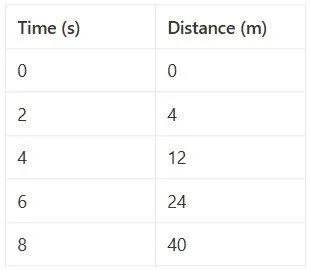
Draw the axes on a piece of graph paper, labeling them "Time (s)" for the horizontal axis and "Distance (m)" for the vertical axis.
Plot the points using the data from the table. For example, at time 2 seconds, plot a point at (2, 4), where 2 is the time and 4 is the distance.
Connect the plotted points with a smooth line that best represents the trend of the data.
Analyze the graph: In this case, the graph should show an upward-sloping line, indicating a consistent increase in distance over time. The steeper the slope, the faster the object is moving.
Summary
Drawing distance-time graphs from measurements is a fundamental skill in physics. By accurately plotting points and connecting them with a line, you create a visual representation of an object's motion. Interpreting the graph's shape, slope, and patterns can provide valuable insights into the object's speed, direction, and behaviour. Distance-time graphs help us analyze and describe motion in a clear and intuitive manner.
Looking for a more dynamic learning experience?
Explore our engaging video lessons and interactive animations that GoPhysics has to offer – your gateway to an immersive physics education!
GCSE Physics Tutorial: Calculating Acceleration from a Distance-Time Graph Using Tangents
Distance-time graphs provide valuable information about an object's motion, and they can be used to calculate acceleration by analysing the slope (gradient) of the graph. When dealing with non-uniform acceleration, you can determine acceleration at a specific time by drawing a tangent line to the graph and calculating its gradient. In this tutorial, we'll explore how to calculate acceleration from a distance-time graph using tangents.
Tangent and Gradient for Non-Uniform Motion
In situations where an object's acceleration is not constant, you can calculate acceleration at a specific time by drawing a tangent line to the distance-time graph at that time. The gradient of this tangent line represents the instantaneous speed at that exact moment.
Steps to Calculate Acceleration Using Tangents
To calculate acceleration from a distance-time graph using tangents, follow these steps:
Identify the Time: Determine the specific time at which you want to calculate the acceleration.
Draw the Tangent: Draw a tangent line to the graph at the chosen time. This tangent should touch the graph at that exact point.
Calculate the Tangent Gradient: Measure the gradient (change in distance divided by change in time) of the tangent line. This gradient represents the instantaneous speed at the chosen time.
Convert Speed to Acceleration: Since acceleration is the rate of change of speed, you can use the gradient of the tangent as the instantaneous speed. Then, calculate acceleration using the following formula:
Acceleration = (Instantaneous Speed - Initial Speed) / Time Interval
Here, the time interval is very small and approaches zero, representing the exact moment.
Example Calculation
Let's say you have a distance-time graph, and you want to calculate acceleration at 5 seconds. You draw a tangent line at that point and measure the gradient as 8 m/s². If the initial speed at that time is 4 m/s, you can calculate acceleration:
Acceleration = (8 m/s² - 4 m/s) / 0.001 s
Acceleration ≈ 4000 m/s²
Summary
Calculating acceleration from a distance-time graph using tangents allows you to determine instantaneous acceleration at a specific time during non-uniform motion. By drawing a tangent line to the graph and calculating its gradient, you can estimate the object's instantaneous speed at that moment. Converting this speed into acceleration provides insights into how the object's velocity is changing rapidly at a precise point in time.
Looking for a more dynamic learning experience?
Explore our engaging video lessons and interactive animations that GoPhysics has to offer – your gateway to an immersive physics education!
GCSE Physics Tutorial: Change in Gradient on a Distance-Time Graph for Acceleration
In the realm of physics, distance-time graphs provide a visual representation of an object's motion. When an object is accelerating, its speed is changing over time, which leads to a distinctive change in the gradient of the distance-time graph. In this tutorial, we'll explore how the change in gradient on a distance-time graph indicates acceleration and how to interpret this change qualitatively.
Acceleration and Change in Speed
Acceleration refers to the rate of change of an object's velocity. When an object accelerates, it either speeds up or slows down, meaning its speed changes. This change in speed has a direct impact on the gradient of the distance-time graph.
Change in Gradient for Acceleration
On a distance-time graph, a change in gradient indicates a change in speed. When an object is accelerating, the graph's gradient becomes steeper or shallower, depending on the direction of acceleration.
Steeper Gradient: If the gradient becomes steeper as time progresses, it indicates that the object is accelerating and its speed is increasing. This can occur during positive acceleration (speeding up).
Shallower Gradient: If the gradient becomes shallower, it suggests that the object is decelerating, meaning its speed is decreasing. This occurs during negative acceleration (slowing down).
Qualitative Interpretation
Imagine a car starting from rest and gradually speeding up. On a distance-time graph, the line representing the car's motion would start with a shallow gradient and become steeper as time goes on. This indicates acceleration—the car is covering more distance in the same amount of time as it speeds up.
Similarly, if a car is moving at a constant speed and then begins to slow down, the distance-time graph's line would transition from a steeper gradient to a shallower one. This change in gradient reflects the deceleration, or negative acceleration, as the car slows down.
Summary
Recalling that a change in gradient on a distance-time graph indicates acceleration is crucial for understanding how the speed of an object changes over time. Steeper gradients indicate positive acceleration (speeding up), while shallower gradients indicate negative acceleration (slowing down). By interpreting these changes in the graph, you can qualitatively determine when an object is accelerating and gain insights into its changing motion.
Looking for a more dynamic learning experience?
Explore our engaging video lessons and interactive animations that GoPhysics has to offer – your gateway to an immersive physics education!
GCSE Physics Tutorial: Calculating Speed from the Gradient of a Distance-Time Graph
Distance-time graphs offer a wealth of information about an object's motion, including its speed. By analysing the gradient (slope) of a distance-time graph, you can calculate the speed of the object. In this tutorial, we'll explore how to calculate speed from the gradient of a distance-time graph and understand the relationship between the two.
The Relationship between Gradient and Speed
In a distance-time graph, the gradient (slope) of the line represents the rate of change of distance with respect to time. Mathematically, the gradient is calculated as:
Gradient = Change in Distance / Change in Time
For an object moving at a constant speed, the distance-time graph is a straight line. The gradient of this line is equal to the speed of the object.
Steps to Calculate Speed from Gradient
To calculate the speed of an object from the gradient of a distance-time graph, follow these steps:
Identify the Line Segment: Determine the section of the graph that corresponds to the object's motion at a constant speed. This will be a straight line.
Choose Two Points: Select two points on the line segment. These points should be clearly defined on the graph, such as where the line intersects gridlines.
Calculate Change in Distance and Time: Find the change in distance (vertical difference) and the change in time (horizontal difference) between the two selected points.
Calculate Speed: Divide the change in distance by the change in time to calculate the speed.
Example Calculation
Let's say you have a distance-time graph with a straight line segment between points A and B. The change in distance between A and B is 200 meters, and the change in time is 20 seconds. To calculate the speed:
Gradient (Speed) = Change in Distance / Change in TimeSpeed = 200 m / 20 s = 10 m/s
The speed of the object is 10 meters per second.
Summary
Calculating speed from the gradient of a distance-time graph involves determining the slope of the line that represents the object's motion at a constant speed. By selecting two points on the line and calculating the change in distance and time between them, you can directly compute the speed. Understanding this relationship allows you to interpret distance-time graphs and extract valuable information about an object's motion without needing to use complex equations.
Looking for a more dynamic learning experience?
Explore our engaging video lessons and interactive animations that GoPhysics has to offer – your gateway to an immersive physics education!
GCSE Physics Tutorial: Representing Motion with Distance-Time Graphs
In the study of physics, distance-time graphs provide a visual representation of how an object's position changes over time when it moves in a straight line. These graphs offer valuable insights into an object's speed, direction, and behavior. In this tutorial, we'll explore how to interpret and use distance-time graphs to understand the motion of objects moving in a straight line.
Basics of Distance-Time Graphs
A distance-time graph plots the distance an object travels on the vertical axis and time on the horizontal axis. Each point on the graph corresponds to a specific time and distance, allowing us to analyse an object's motion over a given period.
Constant Speed
When an object moves with constant speed in a straight line, the distance-time graph takes the form of a straight line with a positive slope. This indicates that the object covers an equal amount of distance in equal intervals of time.
Changing Speed
When an object's speed changes, the graph will show curved segments or a changing slope. Steeper slopes represent higher speeds, while shallower slopes indicate slower speeds.
Stationary Object
If an object is stationary, the distance-time graph will be a horizontal line at the point representing zero distance. This indicates that the object remains at the same position over time.
Example Interpretation
Imagine a car traveling on a straight road. If its distance-time graph is a straight line sloping upwards, it means the car is moving with constant speed. A steeper slope indicates a higher speed, while a shallower slope indicates a slower speed.
If the graph shows curved segments, it indicates that the car's speed is changing. A steeper curve implies an acceleration or deceleration, while a gentler curve signifies a gradual change in speed.
If the graph is a horizontal line, it means the car is stationary and not moving at all.
Summary
Recalling that an object's motion in a straight line can be represented by a distance-time graph is fundamental for understanding the relationship between distance and time in physics. By analysing the slope and shape of the graph, you can deduce whether the object is moving at a constant speed, changing speed, or stationary. Distance-time graphs offer a powerful tool for visualising and interpreting the motion of objects in a clear and intuitive manner.
Looking for a more dynamic learning experience?
Explore our engaging video lessons and interactive animations that GoPhysics has to offer – your gateway to an immersive physics education!