GCSE Physics Tutorial: Renewable Energy Resources
Renewable energy resources are essential components of our transition towards a sustainable and environmentally friendly energy future. Understanding what defines a renewable energy resource helps us identify whether a specific resource is renewable or not. In this tutorial, we will define renewable energy resources and learn how to identify whether a resource falls under this category.
1. Definition of Renewable Energy Resource: A renewable energy resource is a natural source of energy that can be replenished or renewed at a rate equal to or greater than its rate of consumption. These resources are considered sustainable because they are continuously available and can be harnessed without depleting their finite supply.
2. Characteristics of Renewable Energy Resources: Renewable energy resources possess the following characteristics:
a) Replenishable: Renewable resources are naturally replenished through natural processes or cycles. For example, solar energy is constantly supplied by the sun, and wind energy is generated due to atmospheric processes.
b) Sustainable: These resources are considered sustainable as their use does not deplete their availability. They can be used repeatedly over extended periods without running out.
c) Environmentally Friendly: Renewable energy resources generally have lower environmental impacts compared to non-renewable sources like fossil fuels. They produce little or no greenhouse gas emissions, contributing to reduced air pollution and climate change mitigation.
3. Examples of Renewable Energy Resources: Several examples of renewable energy resources include:
a) Solar Energy: Derived from the sun's rays, solar energy can be harnessed using solar panels (photovoltaic cells) to generate electricity and heat water.
b) Wind Energy: Wind turbines convert the kinetic energy of the wind into electricity, making wind energy a valuable renewable resource.
c) Hydropower: Energy from flowing water, such as rivers or dams, is harnessed using hydropower to generate electricity.
d) Geothermal Energy: Geothermal power plants utilise the Earth's heat from volcanic or tectonic activity to produce electricity and heating.
e) Biomass Energy: Biomass, derived from organic materials like wood, agricultural waste, and animal dung, can be burned to generate heat and electricity.
f) Tidal Energy: Tidal turbines convert the kinetic energy of ocean tides into electricity, providing a reliable renewable energy source.
4. Identifying Whether a Resource is Renewable or Not: To identify whether a resource is renewable, consider the following:
a) Natural Source: Renewable energy resources must originate from natural sources and processes. Examples include solar radiation, wind patterns, flowing water, and geothermal heat.
b) Continuous Availability: The resource should be available on an ongoing basis, and its rate of consumption should not exceed its rate of replenishment.
c) Minimal Environmental Impact: Renewable energy resources typically have low environmental impacts, especially when compared to non-renewable sources.
Conclusion: Renewable energy resources are natural sources of energy that can be replenished continuously, making them sustainable and environmentally friendly. Understanding the characteristics of renewable resources allows us to identify whether a specific energy source falls into this category. By harnessing renewable energy, we can reduce our reliance on finite and polluting resources, contributing to a cleaner and more sustainable energy future.
Looking for a more dynamic learning experience?
Explore our engaging video lessons and interactive animations that GoPhysics has to offer – your gateway to an immersive physics education!
GCSE Physics Tutorial: Main Energy Resources and Their Functions
Energy resources are essential for powering our modern world, and they can be broadly categorised into renewable and non-renewable sources. In this tutorial, we will list the main energy resources, describe what they are, and explore how they function to generate usable energy.
1. Non-Renewable Energy Resources: Non-renewable energy resources are finite and cannot be replenished on human timescales. They are formed over millions of years and include:
a) Fossil Fuels:
Coal: Coal is a black sedimentary rock formed from plant remains that have been subjected to heat and pressure over millions of years. It is burned to release heat energy, which is used to produce steam and generate electricity in power plants.
Oil (Petroleum): Petroleum is a liquid fossil fuel extracted from underground reservoirs. It is refined to produce gasoline, diesel, and other fuels for transportation and heating.
Natural Gas: Natural gas is primarily composed of methane and is extracted from underground reserves. It is used for electricity generation, heating, and as a fuel for vehicles.
b) Nuclear Energy:
Nuclear Fission: Nuclear fission involves splitting the nucleus of certain atoms, such as uranium-235, to release a tremendous amount of heat energy. This heat is used to generate steam and produce electricity in nuclear power plants.
2. Renewable Energy Resources: Renewable energy resources are replenished naturally and are considered more sustainable. They include:
a) Solar Energy:
Photovoltaic (PV) Cells: PV cells, also known as solar panels, convert sunlight directly into electricity through the photovoltaic effect. They are used to generate electricity for homes, businesses, and large-scale solar power plants.
b) Wind Energy:
Wind Turbines: Wind turbines harness the kinetic energy of the wind to rotate their blades, which drive a generator to produce electricity. Wind farms are used to generate electricity in regions with consistent winds.
c) Hydropower:
Hydroelectric Power Plants: Hydropower uses the kinetic energy of flowing water (rivers, dams) to turn turbines and generate electricity. Dams store water in reservoirs, and when released, the water flows through the turbines, producing electricity.
d) Geothermal Energy:
Geothermal Power Plants: Geothermal energy harnesses heat from the Earth's interior. Geothermal power plants use steam or hot water from underground reservoirs to turn turbines and generate electricity.
e) Biomass Energy:
Biomass Power Plants: Biomass energy is derived from organic materials such as wood, agricultural waste, and animal dung. Biomass power plants burn these materials to produce heat, which is used to generate steam and electricity.
f) Tidal Energy:
Tidal Turbines: Tidal energy uses the kinetic energy of ocean tides to rotate turbines and generate electricity. Tidal power plants are typically located in coastal areas with significant tidal fluctuations.
Conclusion: Energy resources are vital for meeting our energy needs. Non-renewable sources like fossil fuels and nuclear energy provide a significant portion of our energy, but their availability is limited, and their extraction and use can have environmental impacts. On the other hand, renewable energy resources like solar, wind, hydro, geothermal, biomass, and tidal offer sustainable and cleaner alternatives. Understanding these energy resources and how they function helps us make informed decisions to transition towards more environmentally friendly and sustainable energy solutions.
Looking for a more dynamic learning experience?
Explore our engaging video lessons and interactive animations that GoPhysics has to offer – your gateway to an immersive physics education!
GCSE Physics Tutorial: Increasing Efficiency of Intended Energy Transfer
Increasing the efficiency of energy transfer is crucial for optimising various processes, reducing energy waste, and improving overall performance. Whether it's in machines, engines, or systems, improving efficiency helps us make the most out of the input energy provided. In this tutorial, we will explore different ways to increase the efficiency of an intended energy transfer.
1. Minimise Friction: Friction is a force that opposes motion and can cause energy losses in mechanical systems. To increase efficiency, minimise friction by using lubricants, smooth surfaces, and low-friction materials. Well-lubricated and properly maintained components experience less friction and operate more efficiently.
2. Streamline Designs: In machines and systems, streamline the design to reduce drag and air resistance. Aerodynamic shapes and streamlined surfaces help minimise energy losses due to air resistance, improving overall efficiency.
3. Optimise Component Performance: Choose high-quality components with low energy losses to ensure optimal performance. For example, select efficient motors, pumps, and generators that convert input energy more effectively into useful output energy.
4. Heat Recovery: In many processes, heat is generated as a byproduct. Consider implementing heat recovery systems to capture and reuse this waste heat, increasing overall energy efficiency. Such systems are commonly used in industrial processes and power plants.
5. Improve Insulation: Insulate components or systems to reduce heat losses. Proper insulation helps maintain the desired temperature and minimises energy wastage, especially in buildings, refrigeration units, and industrial processes.
6. Use Energy-Efficient Technologies: Adopt energy-efficient technologies and equipment that are designed to minimise energy losses. For example, use LED lighting, energy-efficient motors, and appliances with high energy ratings to improve efficiency.
7. Control Systems and Automation: Implement smart control systems and automation to optimise energy use. Automated systems can adjust processes based on real-time conditions, ensuring energy is used only when necessary, leading to improved efficiency.
8. Recycle and Reuse: Consider recycling and reusing energy or materials in processes. For example, in some industrial processes, waste products can be recycled back into the system to conserve energy and resources.
9. Regular Maintenance: Regularly maintain and service machines and systems to ensure they operate at their optimal efficiency. Poorly maintained equipment may experience higher energy losses and decreased performance.
10. Energy Storage Solutions: In systems with fluctuating energy demands, consider implementing energy storage solutions like batteries or capacitors. These storage systems can store excess energy when it's available and release it when needed, improving overall efficiency.
Conclusion: Increasing the efficiency of an intended energy transfer is essential for optimising processes and reducing energy waste. By minimising friction, streamlining designs, optimising component performance, recovering waste heat, improving insulation, using energy-efficient technologies, implementing automation, recycling and reusing energy, performing regular maintenance, and employing energy storage solutions, we can achieve higher efficiency in various applications. Improving efficiency is a crucial step in building sustainable and energy-efficient systems for a greener and more efficient future.
Looking for a more dynamic learning experience?
Explore our engaging video lessons and interactive animations that GoPhysics has to offer – your gateway to an immersive physics education!
GCSE Physics Tutorial: Efficiency Calculation
Efficiency calculation is a crucial concept in physics that measures how well a device or process converts input energy into useful output energy. It is a fundamental parameter used to assess the performance and effectiveness of various systems and machines. In this tutorial, we will explore the efficiency calculation formula and its significance in physics.
1. Efficiency Definition: Efficiency is a measure of how much useful output energy is obtained from a system compared to the total input energy supplied to that system. It is expressed as a percentage, where 100% efficiency means that all the input energy is converted into useful output energy with no waste.
2. Efficiency Formula: The efficiency of a system can be calculated using the following formula:
Efficiency (%) = (Useful Output Energy / Total Input Energy) x 100%
3. Interpreting Efficiency Values:
An efficiency of 100% indicates that all the input energy is converted into useful output energy, and there is no waste.
An efficiency of less than 100% indicates that some of the input energy is lost or wasted during the conversion process.
An efficiency of 0% means that no useful output energy is obtained, and all the input energy is wasted.
4. Example: Efficiency of a Light Bulb Suppose a light bulb consumes 50 joules of electrical energy and produces 5 joules of light energy. Calculate the efficiency of the light bulb.
Solution: Efficiency (%) = (Useful Output Energy / Total Input Energy) x 100% Efficiency (%) = (5 J / 50 J) x 100% Efficiency (%) = 0.1 x 100% Efficiency (%) = 10%
Explanation: The light bulb has an efficiency of 10%, indicating that only 10% of the electrical energy is converted into light energy, while the remaining 90% is wasted as heat.
5. Significance of Efficiency Calculation:
Efficiency calculation helps in comparing the performance of different devices or systems that serve the same purpose.
It is crucial in designing and optimising energy-efficient machines, engines, and processes, leading to reduced energy consumption and cost savings.
Efficiency calculations are used to assess the effectiveness of renewable energy sources and technologies in converting natural resources into usable energy.
6. Factors Affecting Efficiency: The efficiency of a system can be influenced by various factors, including:
Design and engineering of the system
Friction and resistance in moving parts
Heat losses in energy conversion processes
Energy losses due to inefficiencies in components
Temperature and environmental conditions
7. Improving Efficiency: Efficiency can be improved by:
Reducing friction and resistance in moving parts
Using high-quality components with low energy losses
Enhancing insulation and reducing heat losses
Adopting energy-efficient technologies and designs
Conclusion: Efficiency calculation is a critical aspect of physics that measures the effectiveness of converting input energy into useful output energy. It helps in evaluating the performance of devices and systems and is essential in designing energy-efficient solutions. By understanding efficiency and considering ways to improve it, we can make informed decisions to conserve energy, reduce waste, and develop sustainable technologies for a better future.
Looking for a more dynamic learning experience?
Explore our engaging video lessons and interactive animations that GoPhysics has to offer – your gateway to an immersive physics education!
GCSE Physics Tutorial: Required Practical 2 - Investigating Efficiency of Different Materials as Thermal Insulators
In this required practical, you will investigate the efficiency of different materials as thermal insulators. Thermal insulation is essential for reducing heat transfer between the interior and exterior of buildings, appliances, and various systems. By comparing the insulating properties of different materials, you will gain insights into their effectiveness in reducing heat loss or gain. Let's explore the steps involved in conducting this experiment.
Aim: To investigate and compare the efficiency of different materials as thermal insulators.
Materials Needed:
Heat source (e.g., a beaker of hot water)
Thermometer
Stopwatch or timer
Several small containers (e.g., cups or beakers)
Different materials for insulation (e.g., wool, foam, cotton, aluminum foil, newspaper, bubble wrap, etc.)
Adhesive tape or rubber bands to secure the insulating materials
Measuring cylinder (optional, for water volume measurements)
Procedure:
Prepare your materials: Cut or shape the insulating materials to fit around the small containers. Ensure that each container is wrapped with the same thickness of the insulating material to maintain consistency.
Set up the experiment: Place the heat source (beaker of hot water) on a stable surface. Measure the initial temperature of the hot water using the thermometer. The starting temperature should be consistent for accurate results.
Record initial temperature: Carefully pour a known volume of hot water (e.g., 100 mL) into each small container. Measure and record the initial temperature of the water in each container.
Wrap the containers: Quickly wrap each container with a different insulating material, ensuring it is securely fastened in place with adhesive tape or rubber bands.
Start the timer: Start the stopwatch or timer as soon as all the containers are wrapped with their respective insulating materials.
Monitor temperature change: At regular intervals (e.g., every 1 minute), record the temperature of the water in each container. Continue measuring until the temperatures stabilise or until a sufficient amount of data is collected.
Calculate efficiency: Calculate the efficiency of each insulating material by comparing the temperature change over time. Efficiency can be calculated by dividing the temperature change of the insulated container by the temperature change of the uninsulated (control) container (the container without any insulating material).
Safety Tips:
Handle hot water with care to avoid burns or scalds.
Use appropriate insulation materials that are safe and non-toxic.
Analysis and Conclusion:
Plot a graph of temperature against time for each insulating material.
Analyse the data to identify which material is the most efficient thermal insulator. The steeper the slope of the graph, the faster the temperature changes, indicating better insulation.
Consider factors that might influence the results, such as material thickness, density, and conductivity.
Draw conclusions based on your findings and explain why some materials are more effective as thermal insulators than others.
Extensions:
Investigate the effect of varying material thickness on insulation efficiency.
Explore the impact of different temperatures of hot water on insulation efficiency.
Conclusion: Through this required practical, you have investigated and compared the efficiency of different materials as thermal insulators. Understanding the insulating properties of materials is essential for various applications, including building design, energy conservation, and reducing heat loss in everyday appliances and systems. The results of this experiment will provide valuable insights into the effectiveness of various materials in reducing heat transfer, leading to more informed choices in designing energy-efficient and sustainable solutions.
Example data
Materials Used:
Wool
Foam
Cotton
Aluminum Foil
Newspaper
Bubble Wrap
Initial Temperature of Hot Water: 80°C
Container Size: 100 mL (for each material)
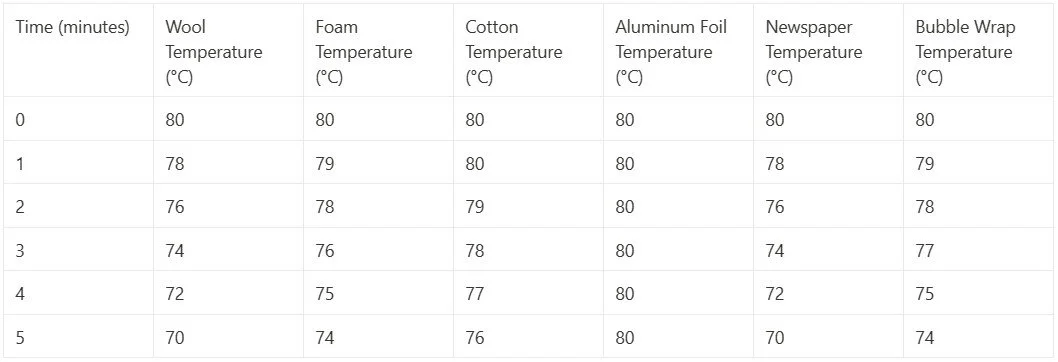
Note: The temperatures in the table are just hypothetical data points for demonstration purposes. In an actual experiment, you would take multiple readings at regular intervals and average them to obtain more accurate and reliable results. The temperatures for the uninsulated container (control) would also be recorded to compare the insulation efficiency of each material.
Analysis:
Plot graphs of temperature against time for each material to visualise the cooling rate.
Calculate the temperature change for each material over time.
Compare the temperature change for each material with the uninsulated container to determine the insulation efficiency.
Conclusion: Based on the data and analysis, you can draw conclusions about the efficiency of different materials as thermal insulators. Identify which material retains heat best and which one allows for faster heat loss. Explain the results and discuss how the properties of the materials influence their insulating capabilities. Remember that in real experiments, more data points and repetitions would be necessary to obtain reliable and accurate conclusions.
Looking for a more dynamic learning experience?
Explore our engaging video lessons and interactive animations that GoPhysics has to offer – your gateway to an immersive physics education!
GCSE Physics Tutorial: How Building Design Affects Rate of Cooling
Building design plays a significant role in influencing the rate at which a building cools down. Factors such as insulation, materials used, and orientation can affect the heat loss and heat transfer mechanisms, ultimately impacting the cooling rate. In this tutorial, we will explore how building design can affect the rate of cooling and the principles behind it.
1. Insulation: Proper insulation is crucial for slowing down heat transfer between the interior and exterior of a building. Insulation materials, such as fiberglass, foam, or mineral wool, reduce heat conduction through walls, ceilings, and floors. Buildings with good insulation retain heat better, allowing them to cool down at a slower rate. Conversely, poorly insulated buildings experience more rapid heat loss, leading to faster cooling.
2. Thermal Mass: The thermal mass of a building refers to its ability to store heat energy. Materials with high thermal mass, such as concrete, stone, or brick, can absorb and store heat during the day and release it at night when temperatures are cooler. This process, known as thermal inertia, slows down the cooling rate of the building and helps maintain a more stable indoor temperature.
3. Orientation and Sunlight Exposure: The orientation of a building and the direction of its windows can impact the amount of sunlight it receives. Buildings with south-facing windows in the Northern Hemisphere (or north-facing windows in the Southern Hemisphere) receive more direct sunlight during the day. This can lead to increased heat gain, requiring more cooling effort. Properly designed shading devices or using reflective coatings on windows can help reduce solar heat gain and improve the cooling rate.
4. Ventilation and Airflow: Effective ventilation and airflow can promote cooling by allowing warm air to escape and allowing cooler air to enter the building. Properly designed ventilation systems, such as windows strategically placed to create cross-ventilation, help maintain a comfortable indoor environment and aid in cooling.
5. Roof Design: The type of roof and its color can influence the cooling rate of a building. Light-colored roofs reflect more sunlight and absorb less heat, reducing the heat gain in the building. This "cool roof" design helps maintain lower indoor temperatures, especially in hot climates.
6. Window Glazing and Frames: Double-glazed or triple-glazed windows with low-emissivity coatings reduce heat transfer through windows, improving insulation and reducing cooling loads. Additionally, using thermally broken window frames helps minimise heat conduction and energy loss.
7. Energy-Efficient Cooling Systems: Using energy-efficient cooling systems, such as heat pumps or evaporative coolers, can minimise energy consumption while maintaining comfortable indoor temperatures. Properly sized and maintained cooling systems ensure effective cooling without unnecessary energy waste.
Conclusion: Building design significantly influences the rate of cooling by affecting heat transfer mechanisms and energy consumption. Proper insulation, thermal mass, orientation, sunlight exposure, ventilation, roof design, window glazing, and energy-efficient cooling systems all play essential roles in creating comfortable indoor environments and reducing cooling loads. Understanding the principles of building design and its impact on the cooling rate is crucial for creating energy-efficient, sustainable, and comfortable living and working spaces.
Looking for a more dynamic learning experience?
Explore our engaging video lessons and interactive animations that GoPhysics has to offer – your gateway to an immersive physics education!
GCSE Physics Tutorial: Thermal Conductivity Rate
Thermal conductivity rate is a fundamental concept in physics that measures the ability of a material to conduct heat. It describes how efficiently heat energy is transferred through a substance. Understanding thermal conductivity is crucial for various applications, such as designing insulation materials and evaluating the performance of heat exchange systems. In this tutorial, we will explore thermal conductivity rate and its significance in heat transfer.
1. Definition of Thermal Conductivity Rate: Thermal conductivity rate is a property of a material that quantifies its ability to conduct heat. It represents the rate of heat transfer through a unit thickness of the material when there is a temperature difference across it. Materials with high thermal conductivity can efficiently conduct heat, while those with low thermal conductivity transfer heat at a slower rate.
2. Units of Thermal Conductivity: Thermal conductivity is typically measured in watts per meter Kelvin (W/mK) in the International System of Units (SI). This unit represents the amount of heat (in watts) transferred through a one-meter thick material with a temperature difference of one Kelvin (or one degree Celsius) per unit time.
3. Factors Affecting Thermal Conductivity: Thermal conductivity is influenced by various factors, including:
Material Composition: Different materials have varying thermal conductivities based on their atomic and molecular structures. Metals, for example, generally have high thermal conductivities, while insulating materials have lower values.
Temperature: Thermal conductivity can change with temperature. In some materials, thermal conductivity increases with temperature, while in others, it decreases.
Density: In general, higher-density materials tend to have higher thermal conductivities due to closer atomic or molecular packing.
4. Significance and Applications: Thermal conductivity rate plays a crucial role in numerous applications:
Building Insulation: Materials with low thermal conductivity are used for insulation to reduce heat transfer between the interior and exterior of buildings, improving energy efficiency.
Heat Exchange Systems: Understanding thermal conductivity is vital in designing efficient heat exchangers for devices like radiators and heat sinks.
Electronics: Thermal conductivity is considered when selecting materials for electronic devices to dissipate heat generated during operation.
5. Example: Suppose we have two metal rods with different thermal conductivities—Rod A with a thermal conductivity of 200 W/mK and Rod B with a thermal conductivity of 50 W/mK. If both rods have the same temperature difference across them and the same length, compare the rate of heat transfer through each rod.
Solution: The rate of heat transfer is directly proportional to the thermal conductivity. Therefore, Rod A will transfer heat at a higher rate than Rod B due to its higher thermal conductivity.
6. Materials with High Thermal Conductivity: Some materials with high thermal conductivity include metals like copper, aluminum, and silver. These materials are commonly used in applications where efficient heat transfer is essential.
7. Materials with Low Thermal Conductivity: Materials with low thermal conductivity are often used for insulation purposes. Examples include glass, wood, and various types of plastics.
Conclusion: Thermal conductivity rate is a crucial property that measures how efficiently a material conducts heat. It has practical applications in designing insulation, heat exchange systems, and electronic devices. Understanding thermal conductivity helps in selecting suitable materials for various applications and optimising energy efficiency in thermal processes. The concept of thermal conductivity rate is an essential component of the study of heat transfer and its applications in everyday life and engineering.
Looking for a more dynamic learning experience?
Explore our engaging video lessons and interactive animations that GoPhysics has to offer – your gateway to an immersive physics education!
GCSE Physics Tutorial: Ways to Reduce Waste Energy
Reducing waste energy is crucial for improving the efficiency and sustainability of various processes and systems. By minimising energy losses, we can conserve valuable resources and reduce environmental impact. In this tutorial, we will explore practical ways to reduce waste energy in different contexts.
1. Improving Energy Efficiency in Appliances:
Use energy-efficient appliances: Opt for appliances with high energy efficiency ratings, such as Energy Star-rated devices. These appliances consume less energy and can significantly reduce waste energy.
Unplug unused devices: Turn off and unplug electronic devices when not in use to prevent standby power consumption, which wastes energy.
2. Insulating Buildings and Spaces:
Proper insulation: Ensure buildings and spaces are well-insulated to reduce heat transfer through walls, windows, and roofs. This minimises the need for heating and cooling systems, reducing energy waste.
Use weatherstripping: Seal gaps around doors and windows with weatherstripping to prevent air leaks and improve energy efficiency.
3. Efficient Lighting Solutions:
Use LED bulbs: Replace traditional incandescent bulbs with energy-efficient LED bulbs, which consume less energy and have a longer lifespan.
Use motion sensors: Install motion sensors or timers for lights in areas with infrequent use to avoid unnecessary energy consumption.
4. Transportation and Fuel Efficiency:
Opt for public transport or carpooling: Reduce individual car usage by using public transportation or carpooling, which helps minimise fuel consumption and waste energy.
Choose fuel-efficient vehicles: When purchasing a car, choose models with better fuel efficiency to reduce fuel consumption and emissions.
5. Industrial Energy Management:
Conduct energy audits: Industries can benefit from regular energy audits to identify areas of energy waste and implement energy-saving strategies.
Optimise processes: Improve manufacturing processes to minimise energy losses, such as using waste heat recovery systems and optimising equipment performance.
6. Renewable Energy Sources:
Harness renewable energy: Shift to renewable energy sources like solar, wind, and hydropower, which have lower environmental impact and reduce reliance on fossil fuels.
Install solar panels: Individuals and businesses can install solar panels to generate their electricity and reduce dependence on grid power.
7. Waste Heat Recovery:
Utilise waste heat: In industrial processes, waste heat can be captured and used to generate additional power or provide heating, reducing energy waste.
8. Education and Awareness:
Promote energy conservation: Raise awareness about the importance of energy conservation and encourage responsible energy use in homes, schools, and workplaces.
Conclusion: Reducing waste energy is essential for improving energy efficiency, conserving resources, and mitigating environmental impacts. By adopting energy-efficient appliances, insulating buildings, using efficient lighting, optimising transportation, implementing industrial energy management strategies, harnessing renewable energy sources, utilising waste heat recovery, and promoting energy conservation, we can collectively contribute to a more sustainable future. Empowering individuals, businesses, and industries to reduce waste energy is a vital step in addressing energy challenges and promoting a cleaner and greener planet.
Looking for a more dynamic learning experience?
Explore our engaging video lessons and interactive animations that GoPhysics has to offer – your gateway to an immersive physics education!
GCSE Physics Tutorial: Examples of Energy Dissipation and Wasted Energy
Energy dissipation occurs when energy is converted and stored in less useful forms, often leading to what is commonly described as "wasted energy." In many processes, energy is not efficiently utilised and is lost in non-recoverable ways. In this tutorial, we will explore examples of energy dissipation and wasted energy in various contexts.
1. Frictional Heating Friction is a force that opposes the relative motion or tendency of such motion of two surfaces in contact. When objects slide, rub, or roll against each other, friction converts useful kinetic energy into heat. This heat energy is often dissipated into the surroundings and is not easily harnessed for practical purposes. For example:
When brakes are applied in a car, friction between the brake pads and the wheels converts the kinetic energy of the moving car into heat, dissipating it into the air.
Rubbing your hands together generates heat due to friction, but this energy is mostly wasted as it is lost to the surroundings.
2. Electrical Resistance in conductors, such as wires, causes the conversion of electrical energy into heat. When a current flows through a conductor with resistance, such as a filament in an incandescent bulb or an electric heater, a significant amount of electrical energy is dissipated as heat. In incandescent bulbs, a large portion of the electrical energy is wasted as heat rather than producing light, making them less energy-efficient compared to other lighting technologies.
3. Sound Energy Dissipation in many mechanical systems, vibrations and sound are produced as energy is transferred. Often, a significant amount of energy is dissipated as sound energy, which is not always useful. For instance:
When striking a bell, the mechanical energy applied is dissipated as sound energy, and only a fraction of it remains in the form of audible sound.
In audio systems, energy is converted into sound waves, but some of it may be lost as heat or vibrations in the system, reducing the overall efficiency.
4. Air Resistance or drag is the force that opposes the motion of an object through the air. When objects move through the air, energy is dissipated due to air resistance. For example:
A skydiver experiences air resistance during freefall, which dissipates some of the gravitational potential energy as heat in the surrounding air.
A cyclist encounters air resistance while riding, which reduces the overall efficiency and requires more energy to maintain speed.
5. Mechanical Energy Loss In mechanical systems, energy may be lost due to factors such as inefficient transmission, wear and tear, or inelastic collisions. For instance:
In a mechanical clock, energy is gradually lost due to friction in the gears, causing the clock to slow down over time.
In collisions, some of the kinetic energy of the colliding objects is converted into heat, sound, or other forms of energy, resulting in an overall loss of energy.
Conclusion: Energy dissipation occurs when energy is stored in less useful forms, often referred to as "wasted energy." Examples such as frictional heating, electrical resistance, sound energy dissipation, air resistance, and mechanical energy loss demonstrate that energy is not always efficiently utilised and is often lost in non-recoverable ways. Understanding these examples of wasted energy is crucial in developing more efficient systems and minimising energy losses in various processes.
Looking for a more dynamic learning experience?
Explore our engaging video lessons and interactive animations that GoPhysics has to offer – your gateway to an immersive physics education!
GCSE Physics Tutorial: Energy Transfer with No Net Energy Change
Energy transfer occurs when energy is exchanged between different objects or systems. In certain scenarios, energy transfer can take place without any net change in the total energy of the system. This phenomenon is described as no net energy change. In this tutorial, we will explore examples of energy transfer where the total energy remains constant.
1. Example: Pendulum Consider a simple pendulum swinging back and forth. At the highest point of its swing (maximum height), the pendulum has maximum potential energy due to its position above the resting point. As it swings down, potential energy is converted into kinetic energy, which is the energy associated with its motion. At the lowest point of the swing, the pendulum has maximum kinetic energy, but its potential energy is now zero. However, as the pendulum swings back up, kinetic energy is converted back into potential energy, and the process repeats. Throughout the pendulum's motion, there is no net energy change; the total energy (potential + kinetic) remains constant.
2. Example: Simple Harmonic Oscillator A spring-mass system is an example of a simple harmonic oscillator. When the mass is at the equilibrium position (neither compressed nor stretched), it has maximum potential energy stored in the spring. As the mass is displaced from the equilibrium position and allowed to oscillate, the potential energy is converted into kinetic energy. At the maximum displacement (amplitude), the potential energy is zero, and the kinetic energy is at its maximum. As the mass moves back towards the equilibrium position, the kinetic energy is converted back into potential energy. The process continues, and there is no net energy change; the total energy (potential + kinetic) remains constant.
3. Example: Water Cycle The water cycle is a natural process involving the continuous movement and transformation of water on Earth. Water evaporates from oceans, lakes, and rivers, gaining energy in the form of heat from the Sun. As the water vapor rises and cools, it condenses into clouds, releasing the energy gained during evaporation. Eventually, the water droplets in the clouds fall as precipitation, such as rain or snow, gaining potential energy due to their position above the ground. As the water returns to the surface, it can flow into rivers and eventually reach the oceans, completing the cycle. Throughout the water cycle, there is no net energy change; the total energy of the water remains constant.
4. Importance of No Net Energy Change: The concept of no net energy change is essential in understanding the conservation of energy in various natural and physical processes. It helps us analyse and predict the behaviour of systems and processes without losing track of the overall energy conservation.
Conclusion: Energy transfer can occur without any net change in the total energy of the system. Examples such as the pendulum, simple harmonic oscillator, and water cycle demonstrate that energy can be converted and exchanged between different forms without any overall energy gain or loss. The concept of no net energy change is fundamental in the study of energy conservation and helps us understand the behaviour of various systems and natural processes.
Looking for a more dynamic learning experience?
Explore our engaging video lessons and interactive animations that GoPhysics has to offer – your gateway to an immersive physics education!
GCSE Physics Tutorial: The Law of Conservation of Energy
The law of conservation of energy is a fundamental principle in physics, stating that energy cannot be created or destroyed but can only be transferred or transformed from one form to another. This principle plays a crucial role in understanding the behavior of energy in various physical processes. In this tutorial, we will explore the law of conservation of energy and its significance in physics.
1. The Law of Conservation of Energy: The law of conservation of energy states that the total energy of an isolated system remains constant over time. In other words, the total energy before and after any process remains the same, as energy is neither created nor destroyed.
2. Energy Transformations: Energy can change from one form to another. For example, potential energy can be converted to kinetic energy, electrical energy can be transformed into light and heat, and chemical energy can be converted to mechanical energy.
3. Mathematical Expression of the Law: The law of conservation of energy can be expressed mathematically as follows:
Total Initial Energy = Total Final Energy
This equation implies that the sum of all types of energy (kinetic, potential, thermal, electrical, etc.) before a process is equal to the sum of all types of energy after the process has occurred.
4. Example of Conservation of Energy: Consider a ball falling freely from a certain height. At the top, it has potential energy due to its position above the ground. As the ball falls, this potential energy is converted into kinetic energy, which is the energy associated with its motion. When the ball reaches the ground, its potential energy becomes zero, but its kinetic energy is at its maximum. According to the law of conservation of energy, the total energy of the system (ball + Earth) remains constant throughout this process.
5. Applications of the Law: The law of conservation of energy is applied in various scientific and engineering fields:
It helps in analysing energy transfer and transformation in various processes, such as mechanical motion, heat transfer, and chemical reactions.
The law is fundamental in designing energy-efficient systems and understanding the behavior of energy in complex systems.
6. Exceptions: In extremely complex systems or situations involving relativistic effects or nuclear reactions, the law of conservation of energy might not appear to hold true. However, these situations are often considered special cases and fall within the framework of more comprehensive physical principles, such as the conservation of mass energy.
Conclusion: The law of conservation of energy is a fundamental principle in GCSE Physics, stating that energy cannot be created or destroyed but can only change from one form to another. This law allows us to understand and analyse energy transfer and transformation in various physical processes. From simple scenarios like falling objects to complex systems, the conservation of energy remains a fundamental and universally applicable principle in the study of physics.
Looking for a more dynamic learning experience?
Explore our engaging video lessons and interactive animations that GoPhysics has to offer – your gateway to an immersive physics education!
GCSE Physics Tutorial: Examples Demonstrating the Definition of Power
Let's explore some examples that illustrate the concept of power, showcasing how power calculations help us understand the rate of energy transfer or transformation in various scenarios. These examples demonstrate the practical application of power in everyday situations and engineering contexts.
Example 1: Electric Kettle Suppose you have an electric kettle that consumes 2000 joules of electrical energy to heat water and bring it to a boil in 20 seconds. Calculate the power of the electric kettle.
Solution: Power (P) = Energy Transferred (E) / Time (t) Power (P) = 2000 J / 20 s Power (P) = 100 W (watts)
Explanation: The electric kettle operates at a power of 100 watts, meaning it transfers energy at a rate of 100 joules per second. This information is valuable when choosing an appropriate electrical supply and assessing its efficiency.
Example 2: A Car Engine Consider a car engine that delivers 100,000 joules of energy during combustion in 10 seconds. Calculate the power output of the car engine.
Solution: Power (P) = Energy Transferred (E) / Time (t) Power (P) = 100,000 J / 10 s Power (P) = 10,000 W (watts) or 10 kW (kilowatts)
Explanation: The car engine operates at a power output of 10,000 watts or 10 kilowatts, which indicates how much energy it can deliver per second. This measurement is crucial for assessing the performance and efficiency of the engine.
Example 3: A Wind Turbine Suppose a wind turbine generates 500,000 joules of electrical energy in 40 seconds. Calculate the power output of the wind turbine.
Solution: Power (P) = Energy Transferred (E) / Time (t) Power (P) = 500,000 J / 40 s Power (P) = 12,500 W (watts) or 12.5 kW (kilowatts)
Explanation: The wind turbine operates at a power output of 12,500 watts or 12.5 kilowatts, representing the rate at which it converts wind energy into electrical energy. This information is essential for assessing the turbine's efficiency and energy production capacity.
Example 4: A Flashlight Consider a flashlight that consumes 500 joules of electrical energy in 5 seconds. Calculate the power of the flashlight.
Solution: Power (P) = Energy Transferred (E) / Time (t) Power (P) = 500 J / 5 s Power (P) = 100 W (watts)
Explanation: The flashlight operates at a power of 100 watts, indicating the rate at which it consumes electrical energy to produce light. This measurement helps understand the flashlight's energy efficiency and its battery requirements.
Conclusion: These examples demonstrate the practical application of power calculations in various scenarios. Power allows us to assess the rate at which energy is transferred or transformed in different devices and systems. Understanding power is crucial for analysing the efficiency and performance of machines, engines, electrical circuits, and everyday appliances. This knowledge has practical applications in various scientific, engineering, and technological fields, making it a fundamental concept in the study of physics.
Looking for a more dynamic learning experience?
Explore our engaging video lessons and interactive animations that GoPhysics has to offer – your gateway to an immersive physics education!
GCSE Physics Tutorial: Calculating Power
Calculating power is a fundamental concept in physics, providing insights into the rate at which energy is transferred or transformed in various systems and devices. Understanding power calculations is essential for analysing the efficiency and performance of machines, appliances, and electrical circuits. In this tutorial, we will explore how to calculate power and its significance in physics.
1. Formula for Power: The formula for calculating power is:
Power (P) = Energy Transferred (E) / Time (t)
Where:
Power (P) is measured in watts (W).
Energy Transferred (E) is measured in joules (J).
Time (t) is measured in seconds (s).
2. Calculating Power: To calculate power, you need to know the amount of energy transferred or the work done (E) and the time (t) it takes to transfer that energy or perform the work. By dividing the energy transferred by the time taken, you can find the power of the system or device.
3. Units of Power: In the International System of Units (SI), power is measured in watts (W). One watt is equal to one joule per second (1 W = 1 J/s). It represents the rate of energy transfer or transformation.
4. Importance and Applications: Calculating power is vital in various scientific and engineering applications:
It helps analyse the performance of machines, engines, and devices by measuring how much work they can do in a given time.
Power calculations are essential in designing and optimising electrical circuits and systems.
Power is a key parameter in calculating the energy consumption and efficiency of appliances and equipment.
5. Example: Suppose an electric motor transfers 4000 joules of energy to perform work in 8 seconds. Calculate the power of the electric motor.
Solution: Power (P) = Energy Transferred (E) / Time (t) Power (P) = 4000 J / 8 s Power (P) = 500 W (watts)
6. Safety Considerations: Understanding power is essential in dealing with high-energy systems and devices. Proper safety measures and precautions should be followed to prevent accidents and ensure safe operations.
Conclusion: Calculating power, using the formula P = E / t, is a fundamental concept in GCSE Physics. It helps us determine the rate of energy transfer or transformation in various systems and devices. Power calculations are essential in understanding the efficiency and performance of machines, electrical circuits, and appliances. This knowledge has practical applications in various scientific, engineering, and technological fields, making it a fundamental concept in the study of physics.
Looking for a more dynamic learning experience?
Explore our engaging video lessons and interactive animations that GoPhysics has to offer – your gateway to an immersive physics education!
GCSE Physics Tutorial: Equation for Power
The equation for power is a fundamental concept in physics, representing the rate at which work is done or energy is transferred or transformed. Understanding the equation for power is crucial for analysing various systems and devices that involve energy transfer. In this tutorial, we will explore the equation for power and its significance in physics.
1. The Equation for Power: The equation for power is:
Power (P) = Energy Transferred (E) / Time (t)
Where:
Power (P) is measured in watts (W).
Energy Transferred (E) is measured in joules (J).
Time (t) is measured in seconds (s).
2. Calculating Power: The equation for power allows us to calculate the power of a system or device by dividing the amount of energy transferred (or work done) by the time it takes to transfer that energy. This gives us a measure of how quickly the energy is being used or produced.
3. Units of Power: In the International System of Units (SI), power is measured in watts (W). One watt is equal to one joule per second (1 W = 1 J/s). It represents the rate of energy transfer or transformation.
4. Importance and Applications: The equation for power is crucial in various scientific and engineering applications:
It helps analyse the performance of machines, engines, and devices by measuring how much work they can do in a given time.
Power calculations are essential in designing and optimising electrical circuits and systems.
Power is a key parameter in calculating the energy consumption and efficiency of appliances and equipment.
5. Example: Suppose a light bulb transfers 5000 joules of energy in 10 seconds. Calculate the power of the light bulb.
Solution: Power (P) = Energy Transferred (E) / Time (t) Power (P) = 5000 J / 10 s Power (P) = 500 W (watts)
6. Safety Considerations: Understanding power is important in dealing with high-energy systems and devices. Proper safety measures and precautions should be followed to prevent accidents and ensure safe operations.
Conclusion: The equation for power, P = E / t, is a fundamental concept in GCSE Physics, representing the rate of energy transfer or transformation. Power is measured in watts (W) and is used to quantify how quickly work is done or energy is transferred. Understanding power is crucial for analysing the efficiency and performance of machines, devices, and various systems that involve energy transfer. This knowledge has practical applications in various scientific, engineering, and technological fields, making it a fundamental concept in the study of physics.
Looking for a more dynamic learning experience?
Explore our engaging video lessons and interactive animations that GoPhysics has to offer – your gateway to an immersive physics education!
GCSE Physics Tutorial: Power Definition
Power is a fundamental concept in physics, describing the rate at which energy is transferred or transformed. Understanding power is crucial for analysing the efficiency and performance of various devices, machines, and systems. In this tutorial, we will explore the definition of power and its significance in physics.
1. Definition: Power is the rate at which work is done or energy is transferred or transformed in a given amount of time. It quantifies how quickly energy is used or produced.
2. Units of Power: Power is measured in watts (W) in the International System of Units (SI). One watt is equal to one joule per second (1 W = 1 J/s).
3. Formula for Power: The formula to calculate power is:
Power (P) = Energy Transferred (E) / Time (t)
Where:
Power (P) is measured in watts (W).
Energy Transferred (E) is measured in joules (J).
Time (t) is measured in seconds (s).
4. Importance and Applications: Understanding power is essential in various scientific and engineering fields:
It helps analyse the performance of machines, engines, and devices by measuring how much work they can do in a given time.
Power is crucial in designing and optimising electrical circuits and systems.
It is a key parameter in calculating the energy consumption and efficiency of appliances and equipment.
5. Example: Suppose a machine transfers 5000 joules of energy in 10 seconds. Calculate the power of the machine.
Solution: Power (P) = Energy Transferred (E) / Time (t) Power (P) = 5000 J / 10 s Power (P) = 500 W (watts)
6. Safety Considerations: Understanding power is essential in dealing with high-energy systems and devices. Proper safety measures and precautions should be followed to prevent accidents and ensure safe operations.
Conclusion: Power is a fundamental concept in GCSE Physics, describing the rate of energy transfer or transformation. The formula for power is P = E / t, and it is measured in watts (W). Understanding power is crucial for analysing the performance and efficiency of machines, electrical systems, and various devices. This knowledge has practical applications in various scientific, engineering, and technological fields, making it a fundamental concept in the study of physics.
Looking for a more dynamic learning experience?
Explore our engaging video lessons and interactive animations that GoPhysics has to offer – your gateway to an immersive physics education!
GCSE Physics Tutorial: Practical Finding Specific Heat Capacity of a Material
Determining the specific heat capacity of a material is an important practical experiment in physics. This measurement helps us understand how effectively a substance can store or release heat energy when its temperature changes. In this tutorial, we will guide you through the steps to conduct a practical experiment to find the specific heat capacity of a material.
Equipment Required:
Substance or material to be tested (e.g., metal block, liquid, or solid)
Thermometer
Measuring cylinder or beaker
Heater or Bunsen burner (for liquids or solids)
Power supply (for electrical heaters)
Stopwatch or timer
Balance or scale (for measuring mass)
Step-by-Step Procedure:
Preparation:
Weigh the material to determine its mass (m) in kilograms (kg).
Record the initial temperature (θ1) of the material using the thermometer.
Setting Up the Experiment:
If the material is a solid or a metal block, heat it to a known temperature (θ2) using a heater or Bunsen burner. Ensure that the material's temperature is higher than the room temperature to ensure effective heat transfer.
If the material is a liquid, measure a known volume (V) of the liquid using a measuring cylinder or beaker. Heat the liquid to a known temperature (θ2) using a heater or Bunsen burner.
Calculating Energy Transferred:
For solids and metals, we can assume that no heat is lost to the surroundings during the experiment. Therefore, the energy transferred (Q) is given by: Q = mass (m) * specific heat capacity (c) * (θ2 - θ1)
For liquids, we need to consider the energy lost to the surroundings during heating. We can use the formula: Q = mass (m) * specific heat capacity (c) * (θ2 - θ1) + (mass of water in the container) * specific heat capacity of water * (θ2 - θ1)
Recording Data:
Measure the final temperature (θ2) of the material once it reaches thermal equilibrium with the surroundings. Record this temperature.
Calculating Specific Heat Capacity:
Use the data obtained to calculate the specific heat capacity (c) of the material using the formula: c = Q / (mass * ΔT)
Tips and Considerations:
Conduct multiple trials to improve the accuracy of your measurements.
Be careful when handling hot objects or liquids to avoid burns or accidents.
Choose suitable units for mass (kilograms), temperature (degrees Celsius or Kelvin), and energy (Joules).
Conclusion: Finding the specific heat capacity of a material is a valuable practical experiment in GCSE Physics. By conducting this experiment and calculating the specific heat capacity, you gain insights into the thermal properties of different materials. This knowledge has wide-ranging applications, from designing heating and cooling systems to understanding energy transfer in various physical processes.
Looking for a more dynamic learning experience?
Explore our engaging video lessons and interactive animations that GoPhysics has to offer – your gateway to an immersive physics education!
GCSE Physics Tutorial: Specific Heat Capacity Definition
Specific heat capacity is a fundamental concept in thermodynamics, describing the ability of a substance to store or release heat energy when its temperature changes. Understanding specific heat capacity is crucial for analysing thermal processes, heat transfer, and temperature changes in various substances. Let's explore the definition of specific heat capacity and its significance in physics.
1. Definition: Specific heat capacity, often denoted as "c," is a physical property of a substance that quantifies the amount of energy required to change the temperature of a unit mass (usually 1 kilogram) of the substance by 1 degree Celsius (or 1 Kelvin). It measures the substance's ability to absorb or release heat without undergoing a phase change (e.g., melting or boiling).
2. Units of Specific Heat Capacity: Specific heat capacity is measured in joules per kilogram per degree Celsius (J/kg°C) or joules per kilogram per Kelvin (J/kgK). Both units are equivalent, as one degree Celsius is the same as one Kelvin.
3. Formula: The specific heat capacity (c) can be calculated using the following formula:
$$c = \frac{Q}{(m \times ΔT)}$$
Where:
c is the specific heat capacity in J/kg°C or J/kgK.
Q is the energy transferred (in Joules, J) when the temperature of the substance changes.
m is the mass of the substance in kilograms (kg).
ΔT is the change in temperature in degrees Celsius (°C) or Kelvin (K).
4. Importance and Applications: Specific heat capacity is a crucial property in various scientific and engineering applications:
It helps in designing and optimizing heating and cooling systems for buildings and industries.
Understanding specific heat capacity is essential for calculating energy changes during temperature variations and phase transitions (e.g., melting or boiling).
The concept is significant in analyzing heat transfer and energy exchange in engines, machines, and other thermal processes.
5. Example: Suppose we have 2 kg of water at 20°C, and we want to heat it to 80°C. The specific heat capacity of water is approximately 4200 J/kg°C. Calculate the energy required to achieve this temperature change.
Solution: Q = m * c * ΔT Q = 2 kg * 4200 J/kg°C * (80°C - 20°C) Q = 2 kg * 4200 J/kg°C * 60°C Q = 504,000 Joules (J)
6. Safety Considerations: Understanding specific heat capacity is essential in handling substances with varying heat capacities safely. Proper insulation and regulation of heat transfer are important to prevent accidents and burns.
Conclusion: Specific heat capacity is a key concept in GCSE Physics, describing a substance's ability to store or release heat during temperature changes. The formula $$c = \frac{Q}{(m \times ΔT)}$$ allows us to quantify specific heat capacity and calculate energy changes in thermal processes. This knowledge finds applications in various scientific, engineering, and everyday situations, making it a fundamental concept in the study of thermodynamics.
Looking for a more dynamic learning experience?
Explore our engaging video lessons and interactive animations that GoPhysics has to offer – your gateway to an immersive physics education!
GCSE Physics Tutorial: Calculating Energy Stored or Released when Temperature Changes
In physics, understanding the energy stored or released when the temperature of a substance changes is crucial for analysing thermal processes and their effects. This concept is especially relevant in understanding heat transfer, phase changes, and thermodynamics. Let's explore how to calculate the energy stored or released during temperature changes and examine some important related formulas and examples.
1. Specific Heat Capacity (c): Specific heat capacity (c) is a fundamental property of a substance, representing the amount of energy required to change the temperature of 1 kilogram of the substance by 1 degree Celsius (or 1 Kelvin). Specific heat capacity is measured in joules per kilogram per degree Celsius (J/kg°C) or joules per kilogram per Kelvin (J/kgK).
2. Energy Change Formula: The formula to calculate the energy change (Q) when the temperature of a substance changes is:
$Q = m \times c \times ΔT$
Where:
Q is the energy change in Joules (J).
m is the mass of the substance in kilograms (kg).
c is the specific heat capacity of the substance in J/kg°C or J/kgK.
ΔT is the change in temperature in degrees Celsius (°C) or Kelvin (K).
3. Energy Change Calculation Examples:
Example 1: Calculate the energy required to raise the temperature of 2 kg of water by 10 degrees Celsius. (Specific heat capacity of water is approximately 4200 J/kg°C).
Solution: Q = 2 kg * 4200 J/kg°C * 10°C Q = 84,000 Joules (J)
Example 2: Determine the energy released when 5 kg of iron cools down by 50 degrees Celsius. (Specific heat capacity of iron is approximately 450 J/kg°C).
Solution: Q = 5 kg * 450 J/kg°C * (-50°C) [Note: The change in temperature is negative as the iron cools down] Q = -112,500 Joules (J)
4. Phase Change Energy: During a phase change (e.g., solid to liquid or liquid to gas), there is no change in temperature even though energy is being added or released. The energy required or released during a phase change can be calculated using the formula:
$Q = m \times L$
Where:
L is the specific latent heat of the substance in J/kg. It represents the amount of energy required to change the phase of 1 kilogram of the substance at a constant temperature.
5. Applications: Calculating energy changes during temperature variations is essential in various real-world applications, including:
Designing heating and cooling systems for buildings and industries.
Understanding the energy required to change the state of matter during processes like boiling, melting, or condensation.
Analysing heat transfer in engines and machines.
6. Safety Considerations: Understanding energy changes during temperature variations is important in ensuring the safe operation of heating and cooling systems. Proper insulation and regulation of energy transfer help prevent accidents and overheating.
Conclusion: Calculating energy stored or released when temperature changes is a fundamental concept in GCSE Physics. The formula $Q = m \times c \times ΔT$ allows us to quantify the energy involved in temperature variations. Additionally, the formula $Q = m \times L$ helps us understand energy changes during phase transitions. This knowledge is not only essential for academic purposes but also has practical applications in various technological and scientific fields.
Looking for a more dynamic learning experience?
Explore our engaging video lessons and interactive animations that GoPhysics has to offer – your gateway to an immersive physics education!
GCSE Physics Tutorial: Gravitational Potential Energy Calculations
Gravitational potential energy is the energy an object possesses due to its position above the Earth's surface or any other celestial body with a gravitational field. Understanding how to calculate gravitational potential energy is crucial for analysing objects at different heights and understanding their energy at various positions. Let's explore the topic of gravitational potential energy calculations and learn the relevant formulas and examples.
1. Gravitational Potential Energy (GPE) Formula: The formula to calculate the gravitational potential energy of an object near the Earth's surface is:
GPE = mass (m) * gravitational acceleration (g) * height (h)
Where:
GPE is the gravitational potential energy in Joules (J).
mass (m) is the mass of the object in kilograms (kg).
gravitational acceleration (g) is the acceleration due to gravity, approximately 9.8 meters per second squared (m/s^2) on the Earth's surface.
height (h) is the vertical distance from the reference level (usually the ground) in meters (m).
2. Gravitational Potential Energy Calculation Examples:
Example 1: Calculate the gravitational potential energy of a rock with a mass of 2 kg placed on a table at a height of 0.5 meters.
Solution: GPE = 2 kg * 9.8 m/s^2 * 0.5 m GPE = 9.8 Joules (J)
Example 2: Determine the gravitational potential energy of a book weighing 3 kg placed on a shelf at a height of 1.2 meters.
Solution: GPE = 3 kg * 9.8 m/s^2 * 1.2 m GPE = 35.28 Joules (J)
3. Relationship between Gravitational Potential Energy and Height: The gravitational potential energy of an object is directly proportional to its height above the reference level. This means that doubling the height will result in twice the gravitational potential energy while halving the height will lead to half the original gravitational potential energy.
4. Gravitational Potential Energy and Potential Energy Change: The change in gravitational potential energy (ΔGPE) can be calculated when an object moves from one height to another. The formula for potential energy change is:
$$ΔGPE = m \times g \times Δh$$
Where:
ΔGPE is the change in gravitational potential energy in Joules (J).
m is the mass of the object in kilograms (kg).
g is the acceleration due to gravity (approximately 9.8 m/s^2).
Δh is the change in height in meters (m).
5. Applications of Gravitational Potential Energy:
Gravitational potential energy plays a vital role in many engineering applications, such as in hydropower generation, where water is stored at higher elevations to generate electricity.
Understanding gravitational potential energy is important for analysing the motion of objects in free fall or during projectile motion.
6. Safety Considerations: When working with objects at different heights, it's essential to consider potential energy changes due to changes in height. Care should be taken to ensure safety and avoid accidents.
Conclusion: Gravitational potential energy calculations are fundamental in GCSE Physics for understanding the energy stored in objects due to their position above the Earth's surface. The formula GPE = m * g * h allows us to quantify gravitational potential energy, providing valuable insights into the behaviour of objects in a gravitational field. Understanding gravitational potential energy is not only important for academic purposes but also has practical applications in various engineering and scientific fields.
Looking for a more dynamic learning experience?
Explore our engaging video lessons and interactive animations that GoPhysics has to offer – your gateway to an immersive physics education!
GCSE Physics Tutorial: Elastic Potential Energy Calculations
Elastic potential energy is the energy stored in an object when it is stretched or compressed. Understanding how to calculate elastic potential energy is essential for analysing systems involving springs, rubber bands, or any object exhibiting elastic behaviour. Let's explore the topic of elastic potential energy calculations and learn the relevant formulas and examples.
1. Elastic Potential Energy (EPE) Formula: The formula to calculate the elastic potential energy of an object is:
EPE = 0.5 * spring constant (k) * extension (e)^2
Where:
EPE is the elastic potential energy in Joules (J).
spring constant (k) is a measure of the stiffness of the spring in Newtons per meter (N/m).
extension (e) is the displacement from the equilibrium position (resting position) in meters (m).
2. Elastic Potential Energy Calculation Examples:
Example 1: Calculate the elastic potential energy stored in a spring with a spring constant of 200 N/m when it is compressed by 0.2 meters.
Solution: EPE = 0.5 * 200 N/m * (0.2 m)^2 EPE = 0.5 * 200 N/m * 0.04 m^2 EPE = 4 Joules (J)
Example 2: Determine the elastic potential energy stored in a stretched rubber band with a spring constant of 50 N/m and an extension of 0.1 meters.
Solution: EPE = 0.5 * 50 N/m * (0.1 m)^2 EPE = 0.5 * 50 N/m * 0.01 m^2 EPE = 0.25 Joules (J)
3. Relationship between Elastic Potential Energy and Extension: The elastic potential energy of an object is directly proportional to the square of its extension. This means that doubling the extension will result in four times more elastic potential energy while halving the extension will lead to one-fourth of the original elastic potential energy.
4. Applications of Elastic Potential Energy:
Elastic potential energy is utilised in various real-world applications, such as in the suspension systems of vehicles to absorb shocks and vibrations.
It plays a role in sports equipment, like bows and catapults, where elastic potential energy is stored and then released to launch projectiles.
Springs in various devices, such as clocks and toys, rely on elastic potential energy for their operation.
5. Safety Considerations: When dealing with objects or systems that involve elastic potential energy, caution should be exercised. For instance, when stretching or compressing a spring, it has the potential to snap back and cause injury. Always handle such objects with care and follow safety guidelines.
Conclusion: Elastic potential energy calculations are essential in GCSE Physics for understanding the energy stored in stretched or compressed objects. The formula EPE = 0.5 * k * e^2 allows us to quantify the elastic potential energy, providing valuable insights into the behaviour of elastic materials. Understanding elastic potential energy is not only important for academic purposes but also has practical applications in a wide range of everyday devices and systems.
Looking for a more dynamic learning experience?
Explore our engaging video lessons and interactive animations that GoPhysics has to offer – your gateway to an immersive physics education!