GCSE Physics Tutorial: Determining Speed from a Distance-Time Graph
Distance-time graphs offer a clear visual representation of an object's motion over time. By analysing the slope (gradient) of a distance-time graph, you can determine the speed of the object. In this tutorial, we'll guide you through the process of determining speed from a distance-time graph and understanding the relationship between the two.
Relationship between Gradient and Speed
In a distance-time graph, the gradient (slope) of the line represents the rate of change of distance with respect to time. Mathematically, the gradient is calculated as:
Gradient = Change in Distance / Change in Time
For an object moving at constant speed, the distance-time graph is a straight line. The gradient of this line is equal to the speed of the object.
Steps to Determine Speed from a Distance-Time Graph
To determine the speed of an object from a distance-time graph, follow these steps:
Identify a Straight Line Segment: Find a section of the graph where the object's motion is at a constant speed. This segment will be a straight line.
Select Two Points: Choose two points on the straight line segment. These points should be clearly defined on the graph, such as where the line intersects gridlines.
Calculate Change in Distance and Time: Determine the change in distance (vertical difference) and the change in time (horizontal difference) between the two selected points.
Calculate Speed: Divide the change in distance by the change in time to calculate the speed.
Example Calculation
Let's say you have a distance-time graph with a straight line segment between points A and B. The change in distance between A and B is 400 meters, and the change in time is 20 seconds. To determine the speed:
Gradient (Speed) = Change in Distance / Change in TimeSpeed = 400 m / 20 s = 20 m/s
The speed of the object is 20 meters per second.
Summary
Determining speed from a distance-time graph involves analysing the slope of the line that represents the object's motion at a constant speed. By selecting two points on the line, calculating the change in distance and time between them, and then dividing the distance by the time, you can determine the speed of the object. This method allows you to extract valuable information about an object's motion from the graph without needing complex equations.
Looking for a more dynamic learning experience?
Explore our engaging video lessons and interactive animations that GoPhysics has to offer – your gateway to an immersive physics education!
GCSE Physics Tutorial: Drawing Distance-Time Graphs from Measurements
Distance-time graphs are powerful tools for visualizing the motion of objects and understanding how their positions change over time. To create a distance-time graph, you need accurate measurements of the distances an object covers at different points in time. In this tutorial, we'll guide you through the process of drawing distance-time graphs from measurements and interpreting the results.
Steps to Draw a Distance-Time Graph
Gather Data: Collect measurements of the distance an object travels at various points in time. Ensure your measurements are accurate and consistent.
Choose Axes: Draw the axes for your graph. The horizontal axis represents time (usually in seconds), and the vertical axis represents distance (usually in meters).
Plot Points: Plot each data point on the graph, with time on the horizontal axis and distance on the vertical axis. Make sure to label your axes with appropriate units.
Connect the Dots: Draw a smooth line connecting the plotted points. The line should accurately represent the general trend of the data points.
Interpret the Graph: Analyze the shape of the graph. Different slopes, curves, and patterns provide insights into the object's motion.
Example of Drawing a Distance-Time Graph
Let's consider an example where you have measured the distance traveled by a bicycle every 2 seconds:
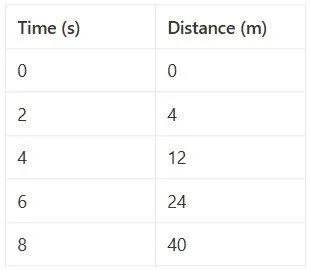
Draw the axes on a piece of graph paper, labeling them "Time (s)" for the horizontal axis and "Distance (m)" for the vertical axis.
Plot the points using the data from the table. For example, at time 2 seconds, plot a point at (2, 4), where 2 is the time and 4 is the distance.
Connect the plotted points with a smooth line that best represents the trend of the data.
Analyze the graph: In this case, the graph should show an upward-sloping line, indicating a consistent increase in distance over time. The steeper the slope, the faster the object is moving.
Summary
Drawing distance-time graphs from measurements is a fundamental skill in physics. By accurately plotting points and connecting them with a line, you create a visual representation of an object's motion. Interpreting the graph's shape, slope, and patterns can provide valuable insights into the object's speed, direction, and behaviour. Distance-time graphs help us analyze and describe motion in a clear and intuitive manner.
Looking for a more dynamic learning experience?
Explore our engaging video lessons and interactive animations that GoPhysics has to offer – your gateway to an immersive physics education!
GCSE Physics Tutorial: Calculating Acceleration from a Distance-Time Graph Using Tangents
Distance-time graphs provide valuable information about an object's motion, and they can be used to calculate acceleration by analysing the slope (gradient) of the graph. When dealing with non-uniform acceleration, you can determine acceleration at a specific time by drawing a tangent line to the graph and calculating its gradient. In this tutorial, we'll explore how to calculate acceleration from a distance-time graph using tangents.
Tangent and Gradient for Non-Uniform Motion
In situations where an object's acceleration is not constant, you can calculate acceleration at a specific time by drawing a tangent line to the distance-time graph at that time. The gradient of this tangent line represents the instantaneous speed at that exact moment.
Steps to Calculate Acceleration Using Tangents
To calculate acceleration from a distance-time graph using tangents, follow these steps:
Identify the Time: Determine the specific time at which you want to calculate the acceleration.
Draw the Tangent: Draw a tangent line to the graph at the chosen time. This tangent should touch the graph at that exact point.
Calculate the Tangent Gradient: Measure the gradient (change in distance divided by change in time) of the tangent line. This gradient represents the instantaneous speed at the chosen time.
Convert Speed to Acceleration: Since acceleration is the rate of change of speed, you can use the gradient of the tangent as the instantaneous speed. Then, calculate acceleration using the following formula:
Acceleration = (Instantaneous Speed - Initial Speed) / Time Interval
Here, the time interval is very small and approaches zero, representing the exact moment.
Example Calculation
Let's say you have a distance-time graph, and you want to calculate acceleration at 5 seconds. You draw a tangent line at that point and measure the gradient as 8 m/s². If the initial speed at that time is 4 m/s, you can calculate acceleration:
Acceleration = (8 m/s² - 4 m/s) / 0.001 s
Acceleration ≈ 4000 m/s²
Summary
Calculating acceleration from a distance-time graph using tangents allows you to determine instantaneous acceleration at a specific time during non-uniform motion. By drawing a tangent line to the graph and calculating its gradient, you can estimate the object's instantaneous speed at that moment. Converting this speed into acceleration provides insights into how the object's velocity is changing rapidly at a precise point in time.
Looking for a more dynamic learning experience?
Explore our engaging video lessons and interactive animations that GoPhysics has to offer – your gateway to an immersive physics education!
GCSE Physics Tutorial: Change in Gradient on a Distance-Time Graph for Acceleration
In the realm of physics, distance-time graphs provide a visual representation of an object's motion. When an object is accelerating, its speed is changing over time, which leads to a distinctive change in the gradient of the distance-time graph. In this tutorial, we'll explore how the change in gradient on a distance-time graph indicates acceleration and how to interpret this change qualitatively.
Acceleration and Change in Speed
Acceleration refers to the rate of change of an object's velocity. When an object accelerates, it either speeds up or slows down, meaning its speed changes. This change in speed has a direct impact on the gradient of the distance-time graph.
Change in Gradient for Acceleration
On a distance-time graph, a change in gradient indicates a change in speed. When an object is accelerating, the graph's gradient becomes steeper or shallower, depending on the direction of acceleration.
Steeper Gradient: If the gradient becomes steeper as time progresses, it indicates that the object is accelerating and its speed is increasing. This can occur during positive acceleration (speeding up).
Shallower Gradient: If the gradient becomes shallower, it suggests that the object is decelerating, meaning its speed is decreasing. This occurs during negative acceleration (slowing down).
Qualitative Interpretation
Imagine a car starting from rest and gradually speeding up. On a distance-time graph, the line representing the car's motion would start with a shallow gradient and become steeper as time goes on. This indicates acceleration—the car is covering more distance in the same amount of time as it speeds up.
Similarly, if a car is moving at a constant speed and then begins to slow down, the distance-time graph's line would transition from a steeper gradient to a shallower one. This change in gradient reflects the deceleration, or negative acceleration, as the car slows down.
Summary
Recalling that a change in gradient on a distance-time graph indicates acceleration is crucial for understanding how the speed of an object changes over time. Steeper gradients indicate positive acceleration (speeding up), while shallower gradients indicate negative acceleration (slowing down). By interpreting these changes in the graph, you can qualitatively determine when an object is accelerating and gain insights into its changing motion.
Looking for a more dynamic learning experience?
Explore our engaging video lessons and interactive animations that GoPhysics has to offer – your gateway to an immersive physics education!
GCSE Physics Tutorial: Calculating Speed from the Gradient of a Distance-Time Graph
Distance-time graphs offer a wealth of information about an object's motion, including its speed. By analysing the gradient (slope) of a distance-time graph, you can calculate the speed of the object. In this tutorial, we'll explore how to calculate speed from the gradient of a distance-time graph and understand the relationship between the two.
The Relationship between Gradient and Speed
In a distance-time graph, the gradient (slope) of the line represents the rate of change of distance with respect to time. Mathematically, the gradient is calculated as:
Gradient = Change in Distance / Change in Time
For an object moving at a constant speed, the distance-time graph is a straight line. The gradient of this line is equal to the speed of the object.
Steps to Calculate Speed from Gradient
To calculate the speed of an object from the gradient of a distance-time graph, follow these steps:
Identify the Line Segment: Determine the section of the graph that corresponds to the object's motion at a constant speed. This will be a straight line.
Choose Two Points: Select two points on the line segment. These points should be clearly defined on the graph, such as where the line intersects gridlines.
Calculate Change in Distance and Time: Find the change in distance (vertical difference) and the change in time (horizontal difference) between the two selected points.
Calculate Speed: Divide the change in distance by the change in time to calculate the speed.
Example Calculation
Let's say you have a distance-time graph with a straight line segment between points A and B. The change in distance between A and B is 200 meters, and the change in time is 20 seconds. To calculate the speed:
Gradient (Speed) = Change in Distance / Change in TimeSpeed = 200 m / 20 s = 10 m/s
The speed of the object is 10 meters per second.
Summary
Calculating speed from the gradient of a distance-time graph involves determining the slope of the line that represents the object's motion at a constant speed. By selecting two points on the line and calculating the change in distance and time between them, you can directly compute the speed. Understanding this relationship allows you to interpret distance-time graphs and extract valuable information about an object's motion without needing to use complex equations.
Looking for a more dynamic learning experience?
Explore our engaging video lessons and interactive animations that GoPhysics has to offer – your gateway to an immersive physics education!
GCSE Physics Tutorial: Representing Motion with Distance-Time Graphs
In the study of physics, distance-time graphs provide a visual representation of how an object's position changes over time when it moves in a straight line. These graphs offer valuable insights into an object's speed, direction, and behavior. In this tutorial, we'll explore how to interpret and use distance-time graphs to understand the motion of objects moving in a straight line.
Basics of Distance-Time Graphs
A distance-time graph plots the distance an object travels on the vertical axis and time on the horizontal axis. Each point on the graph corresponds to a specific time and distance, allowing us to analyse an object's motion over a given period.
Constant Speed
When an object moves with constant speed in a straight line, the distance-time graph takes the form of a straight line with a positive slope. This indicates that the object covers an equal amount of distance in equal intervals of time.
Changing Speed
When an object's speed changes, the graph will show curved segments or a changing slope. Steeper slopes represent higher speeds, while shallower slopes indicate slower speeds.
Stationary Object
If an object is stationary, the distance-time graph will be a horizontal line at the point representing zero distance. This indicates that the object remains at the same position over time.
Example Interpretation
Imagine a car traveling on a straight road. If its distance-time graph is a straight line sloping upwards, it means the car is moving with constant speed. A steeper slope indicates a higher speed, while a shallower slope indicates a slower speed.
If the graph shows curved segments, it indicates that the car's speed is changing. A steeper curve implies an acceleration or deceleration, while a gentler curve signifies a gradual change in speed.
If the graph is a horizontal line, it means the car is stationary and not moving at all.
Summary
Recalling that an object's motion in a straight line can be represented by a distance-time graph is fundamental for understanding the relationship between distance and time in physics. By analysing the slope and shape of the graph, you can deduce whether the object is moving at a constant speed, changing speed, or stationary. Distance-time graphs offer a powerful tool for visualising and interpreting the motion of objects in a clear and intuitive manner.
Looking for a more dynamic learning experience?
Explore our engaging video lessons and interactive animations that GoPhysics has to offer – your gateway to an immersive physics education!
GCSE Physics Tutorial: Motion in a Circle - Constant Speed, Changing Velocity
Understanding motion in a circle is essential for comprehending the concepts of speed, velocity, and acceleration in a dynamic context. In this tutorial, we'll explore why motion in a circle involves both constant speed and changing velocity, using qualitative examples to illustrate these concepts.
Constant Speed in Circular Motion
When an object moves in a circle, it covers the same distance around the circle in equal intervals of time. This indicates a constant speed because the object's distance traveled remains the same for each unit of time. Imagine a race car on a circular track: if it takes 10 seconds to complete one lap, it will take another 10 seconds for the next lap, covering the same distance.
Changing Velocity in Circular Motion
While the speed remains constant, the velocity of an object in circular motion changes. Velocity is a vector quantity that considers both the speed of an object and the direction it's moving. In circular motion, the direction of the object's velocity is continuously changing, which results in a changing velocity.
Imagine a car moving in a circle. As it completes each part of the circular path, its velocity vector points in a different direction. This change in direction of velocity constitutes changing velocity, even though the car maintains a constant speed.
Illustrative Example
Consider a satellite orbiting the Earth. It maintains a constant distance from the planet, so its speed remains unchanged. However, its velocity changes constantly due to the continuously changing direction of motion. At any point along its orbit, the satellite's velocity is tangential to the circle it traces, and this direction keeps changing as it moves around the Earth.
Summary
In motion around a circle, an object experiences constant speed because it covers the same distance around the circle in equal intervals of time. However, due to the continuously changing direction of motion, the object's velocity changes. This means that although the speed remains the same, the object's velocity vector points in different directions as it moves, resulting in a changing velocity. Understanding these concepts is crucial for grasping the complexities of circular motion and vector dynamics.
Looking for a more dynamic learning experience?
Explore our engaging video lessons and interactive animations that GoPhysics has to offer – your gateway to an immersive physics education!
GCSE Physics Tutorial: Difference Between Scalar and Vector Quantities
In physics, quantities are classified into two main categories: scalar and vector. These categories define the type of information a quantity carries, either as a single numerical value (scalar) or as both magnitude and direction (vector). In this tutorial, we'll explore the distinction between scalar and vector quantities by using reference to displacement, distance, speed, and velocity.
Scalar Quantities
Scalar quantities are those that have only magnitude and no direction. They are described solely by a numerical value and a unit. Examples of scalar quantities include:
Distance: The total length of the path traveled by an object. It is a scalar quantity because it only tells us "how much" an object has moved and does not specify the direction.
Speed: The rate of change of distance over time. Speed is scalar because it only indicates how fast an object is moving, without considering the direction.
Vector Quantities
Vector quantities are those that have both magnitude and direction. They require two essential pieces of information to be fully described. Examples of vector quantities include:
Displacement: The change in position of an object from its initial to its final point. Displacement is a vector quantity because it not only indicates the "how much" (magnitude) an object has moved but also the "in which direction" it has moved.
Velocity: The rate of change of displacement with respect to time. Velocity is a vector quantity as it specifies both the "how fast" (magnitude) an object is moving and the "in which direction" it is moving.
Comparison: Scalar vs. Vector
Here's a comparison of scalar and vector quantities using displacement, distance, speed, and velocity as examples:
Distance (Scalar): Distance traveled by an object, only magnitude.
Displacement (Vector): Change in position, includes both magnitude and direction.
Speed (Scalar): Rate of change of distance over time, only magnitude.
Velocity (Vector): Rate of change of displacement over time, includes both magnitude and direction.
Summary
In physics, understanding the difference between scalar and vector quantities is essential for accurately describing and analysing the physical world. Scalar quantities have magnitude only and are described by numerical values, while vector quantities have both magnitude and direction. Displacement, distance, speed, and velocity provide clear examples of how these concepts apply in motion-related contexts.
Looking for a more dynamic learning experience?
Explore our engaging video lessons and interactive animations that GoPhysics has to offer – your gateway to an immersive physics education!
GCSE Physics Tutorial: Define Velocity
In the realm of physics, velocity is a concept closely related to speed, but it encompasses an additional dimension: direction. While speed tells us how fast an object is moving, velocity goes a step further by providing both the magnitude (numerical value) and the direction of the object's motion. In this tutorial, we'll delve into the definition of velocity, its units of measurement, and its relationship with speed.
What is Velocity?
Velocity can be defined as the rate of change of an object's displacement with respect to time. It includes both the speed of an object's motion and the direction in which it's moving. In other words, velocity describes not only "how fast" an object is moving but also "in which direction" it's moving.
Units of Measurement for Velocity
The units of velocity depend on the units used for distance and time. In the International System of Units (SI), velocity is typically measured in meters per second (m/s), just like speed. However, since velocity includes direction, it's often represented as a vector quantity.
Velocity vs. Speed
While velocity and speed are related concepts, they have a crucial distinction: velocity includes direction. Here's a comparison between the two:
Speed: Speed is a scalar quantity that tells us the rate of change of distance over time. It only has magnitude and no direction. For example, if a car is moving at 60 km/h, we know its speed, but not the direction it's moving in.
Velocity: Velocity is a vector quantity that includes both magnitude (speed) and direction. For example, if a car is moving at 60 km/h north, we know both its speed and the direction of its motion.
Calculating Velocity
To calculate velocity, you need to know both the displacement of the object and the time it took for that displacement. Mathematically, velocity can be expressed as:
Velocity (v) = Displacement (Δx) / Time (Δt)
Displacement (Δx): This is the change in position of the object between two points, including both magnitude and direction.
Time (Δt): This is the duration over which the displacement occurred.
Summary
Velocity is the rate of change of an object's displacement with respect to time. It includes both speed and direction.
In the SI system, velocity is typically measured in meters per second (m/s).
Velocity is a vector quantity, while speed is a scalar quantity.
Velocity provides a more comprehensive description of motion than speed, as it takes into account both the magnitude and direction of an object's movement.
Looking for a more dynamic learning experience?
Explore our engaging video lessons and interactive animations that GoPhysics has to offer – your gateway to an immersive physics education!
GCSE Physics Tutorial: Calculating Average Speed from Non-Uniform Motion
In the realm of physics, average speed is a valuable concept that enables us to understand the overall rate of motion of an object, even if its speed is not constant. When dealing with non-uniform motion, where the speed changes over time, calculating the average speed becomes essential to characterise the overall behaviour. In this tutorial, we'll explore how to calculate average speed from non-uniform motion.
Average Speed vs. Instantaneous Speed
Before delving into non-uniform motion, it's important to differentiate between average speed and instantaneous speed:
Average Speed: This is the total distance traveled divided by the total time taken. It gives a sense of the overall pace of motion over a specific interval.
Instantaneous Speed: This is the speed of an object at a particular instant in time. It can vary greatly during non-uniform motion.
Calculating Average Speed from Non-Uniform Motion
When dealing with non-uniform motion, where the speed changes over time, calculating the average speed involves determining the total distance traveled and the total time taken. Here's how you can do it:
Divide the Motion into Intervals: If the motion is not uniform, divide the entire motion into smaller intervals where the speed is relatively constant. For each interval, determine the distance traveled and the time taken.
Calculate the Average Speed for Each Interval: For each interval, calculate the average speed using the formula:
Average Speed (v) = Distance (d) / Time (t)
Total Distance and Total Time: Sum up the distances and times for all intervals to find the total distance (D) and total time (T).
Calculate the Overall Average Speed: Divide the total distance by the total time to calculate the overall average speed:
Overall Average Speed = Total Distance (D) / Total Time (T)
Example Calculation
Let's consider a scenario where a cyclist covers 20 km at 15 km/h for the first 2 hours, and then speeds up to 25 km/h for the next 1 hour. To calculate the average speed:
For the first interval: Average Speed = 20 km / 2 h = 10 km/h
For the second interval: Average Speed = 25 km / 1 h = 25 km/h
Total Distance = 20 km + 25 km = 45 km Total Time = 2 h + 1 h = 3 h
Overall Average Speed = 45 km / 3 h = 15 km/h
The cyclist's average speed over the entire journey is 15 km/h.
Summary
Calculating average speed from non-uniform motion involves breaking down the motion into intervals, calculating average speeds for each interval, and then determining the overall average speed based on the total distance and total time. This approach allows us to describe the overall pace of an object's movement, even when its speed is not constant.
Looking for a more dynamic learning experience?
Explore our engaging video lessons and interactive animations that GoPhysics has to offer – your gateway to an immersive physics education!
GCSE Physics Tutorial: Calculating Speed Using the Speed Equation
In physics, calculating speed is a fundamental skill that enables us to quantify the rate at which an object is moving. The speed equation provides a straightforward method to calculate speed based on known values of distance and time. In this tutorial, we'll explore how to use the speed equation to calculate the speed of an object in motion.
The Speed Equation
The speed equation allows us to calculate speed by dividing the distance traveled by an object by the time it takes to cover that distance. Mathematically, the speed equation is expressed as:
Speed (v) = Distance (d) / Time (t)
Where:
Speed (v) is the rate of movement, typically measured in meters per second (m/s).
Distance (d) is the length of the path an object travels, measured in meters (m).
Time (t) is the duration of the motion, measured in seconds (s).
Steps to Calculate Speed Using the Speed Equation
To calculate the speed of an object using the speed equation, follow these steps:
Determine Distance and Time: Identify the distance the object has traveled (in meters) and the time it took to cover that distance (in seconds).
Plug Values into the Equation: Substitute the distance and time values into the speed equation:
Speed (v) = Distance (d) / Time (t)
Perform the Calculation: Divide the distance by the time to calculate the speed.
Assign Units: Remember to include the appropriate units for speed, which are usually meters per second (m/s) when using the metric system.
Example Calculation
Let's say a car travels a distance of 500 meters in 25 seconds. To calculate its speed:
Speed (v) = Distance (d) / Time (t)Speed (v) = 500 m / 25 s = 20 m/s
The car's speed is 20 meters per second.
Summary
Calculating speed using the speed equation is a fundamental concept in physics that helps us quantify the motion of objects. By knowing the distance an object has traveled and the time it took to cover that distance, you can easily calculate its speed using the formula v = d / t. This method allows you to analyse the motion of various objects, whether they are vehicles, athletes, or other entities, by relating distance and time to the rate of movement.
Looking for a more dynamic learning experience?
Explore our engaging video lessons and interactive animations that GoPhysics has to offer – your gateway to an immersive physics education!
GCSE Physics Tutorial: Measuring Speed Using Distance and Time
In the realm of physics, measuring speed is a fundamental skill that involves quantifying how fast an object is moving. One of the simplest and most common methods to measure speed is by using the concepts of distance and time. In this tutorial, we'll explore how to measure speed using these two essential variables.
The Formula for Speed
Speed is defined as the rate of change of distance over time. Mathematically, speed (v) can be expressed as:
Speed (v) = Distance (d) / Time (t)
Where:
Speed (v) is the rate of movement, typically measured in meters per second (m/s).
Distance (d) is the length of the path an object travels, measured in meters (m).
Time (t) is the duration of the motion, measured in seconds (s).
Steps to Measure Speed
To measure the speed of an object using distance and time, follow these steps:
Select a Distance: Choose a specific distance over which you'll measure the object's motion. This distance should be suitable for the speed range of the object; for instance, a longer distance for a car and a shorter distance for a sprinter.
Start and Stop Timing: Start a timer when the object begins its motion and stop the timer when it reaches the end of the chosen distance.
Measure Time: Record the time it took for the object to travel the chosen distance. Make sure to use the same unit for time as you do for speed (usually seconds).
Calculate Speed: Use the formula for speed to calculate the object's speed. Divide the distance by the time recorded.
Example Calculation
Let's say a bicycle travels a distance of 300 meters in 40 seconds. To measure its speed:
Speed (v) = Distance (d) / Time (t)Speed (v) = 300 m / 40 s = 7.5 m/s
The bicycle's speed is 7.5 meters per second.
Summary
Measuring speed using distance and time is a straightforward yet crucial concept in physics. By determining the distance an object travels and the time it takes to cover that distance, you can calculate its speed using the formula v = d / t. This method is applicable to various scenarios, from analysing the speed of moving objects to understanding the motion of vehicles, athletes, and other entities.
Looking for a more dynamic learning experience?
Explore our engaging video lessons and interactive animations that GoPhysics has to offer – your gateway to an immersive physics education!
GCSE Physics Tutorial: Varying Speed of Sound and Wind
In the world of physics, it's important to recognise that moving objects aren't the only things with varying speeds. The speed of sound and the speed of wind are two examples of how the properties of their respective mediums can lead to differences in velocity. In this tutorial, we'll explore the reasons behind the varying speed of sound and wind and their significance in our understanding of physics.
Speed of Sound
The speed of sound refers to how quickly sound waves travel through a medium, such as air, water, or solids. The speed of sound is not constant; it depends on factors like the medium's composition, temperature, and pressure. Here are a few key points about the varying speed of sound:
Medium: The speed of sound differs based on the medium through which it's traveling. For example, sound travels faster in solids than in liquids, and faster in liquids than in gases like air.
Temperature: In general, the speed of sound increases with higher temperatures. This is because at higher temperatures, particles in the medium have more kinetic energy and can vibrate more rapidly, transmitting sound waves faster.
Pressure: Changes in pressure can also affect the speed of sound, although this effect is less pronounced than temperature. Changes in pressure can alter the density of the medium, which in turn affects the speed of sound.
Altitude: As you move to higher altitudes, the density and temperature of the air change, which impacts the speed of sound. Generally, the speed of sound decreases with increasing altitude.
Wind Speed
The speed of wind, also known as wind velocity, is the rate at which air moves horizontally across the Earth's surface. Wind speed can vary due to several factors, including:
Pressure Gradient: Differences in air pressure between different regions create a pressure gradient force that drives air movement. The greater the pressure difference, the faster the wind will blow.
Friction: Friction with the Earth's surface slows down wind close to the ground. This is why wind speeds are typically faster at higher altitudes where there is less surface friction.
Geography and Topography: The presence of natural barriers like mountains or buildings can influence wind speed. Wind tends to be funneled through valleys and gaps in mountains, increasing its speed.
Temperature Differences: Temperature variations across a region can create pressure differences, leading to the movement of air masses and changes in wind speed.
Summary
Understanding that moving objects aren't the only things with varying speeds is essential for comprehending the behaviour of different phenomena in the physical world. Both the speed of sound and the speed of wind can be influenced by a variety of factors, including the properties of the medium, temperature, pressure, and geographical features. This knowledge contributes to our understanding of wave propagation, atmospheric dynamics, and how various forces shape our environment.
Looking for a more dynamic learning experience?
Explore our engaging video lessons and interactive animations that GoPhysics has to offer – your gateway to an immersive physics education!
GCSE Physics Tutorial: Typical Movement Values
In the realm of physics, understanding typical movement values is crucial for analysing and describing the motion of objects, whether they are humans, vehicles, or other entities. These values provide a baseline for comparison and help us make predictions about various scenarios. In this tutorial, we'll explore some common typical movement values and their significance in physics.
Human Walking Speed
Human walking speed is a fundamental value that varies based on factors such as age, fitness, and purpose of walking. On average, a typical walking speed for an adult is around 1.4 to 1.6 meters per second (m/s), which is equivalent to approximately 5 to 6 kilometers per hour (km/h). However, walking speeds can vary widely:
A brisk walk might reach speeds of 1.7 to 2.0 m/s (6 to 7.2 km/h).
A leisurely stroll could be around 1.0 m/s (3.6 km/h).
Elderly individuals might walk at speeds closer to 0.8 m/s (2.9 km/h).
Running Speed
Running speed involves higher velocities compared to walking. The average running speed for an adult ranges from 2.0 to 3.0 m/s (7.2 to 10.8 km/h). Sprinters, however, can reach much higher speeds, often exceeding 10 m/s (36 km/h) during short bursts of energy.
Vehicle Speeds
Vehicle speeds can vary widely depending on the type of vehicle and the context:
Cars: Urban driving speeds are often around 13 to 30 m/s (30 to 65 mph), while highway speeds can range from 25 to 35 m/s (55 to 80 mph).
Bicycles: Average cycling speeds are around 4.0 to 8.0 m/s (14 to 28 km/h).
Trains: Passenger train speeds range from 18 to 40 m/s (65 to 145 km/h), while high-speed trains can exceed 60 m/s (215 km/h).
Airplanes: Typical takeoff and landing speeds for commercial airplanes range from 60 to 80 m/s (220 to 290 km/h), while cruising speeds are around 220 to 250 m/s (800 to 900 km/h).
Projectile Speeds
In physics, the term projectile refers to an object that's thrown or launched into the air. Projectile speeds can vary based on the angle of launch and the initial velocity. For instance, a typical throwing speed for a baseball pitcher might be around 40 to 50 m/s (144 to 180 km/h), while a basketball player might throw a ball with speeds of 10 to 15 m/s (36 to 54 km/h).
Summary
Recalling typical movement values is essential for understanding and analysing motion in various contexts. These values serve as benchmarks for comparison, prediction, and evaluation. Whether considering human walking and running speeds, vehicle velocities, or projectile motions, typical movement values provide a foundation for interpreting the behaviour of objects in motion.
Looking for a more dynamic learning experience?
Explore our engaging video lessons and interactive animations that GoPhysics has to offer – your gateway to an immersive physics education!
GCSE Physics Tutorial: Factors Affecting Walking Speed
The speed at which people walk can vary due to a multitude of factors. These factors are a result of the intricate interplay between our physical characteristics, the environment, and our personal motivations. In this tutorial, we'll delve into the reasons why the speed of walking may differ among individuals and situations.
1. Individual Fitness and Health:
People's fitness levels and overall health can significantly influence their walking speed. Individuals who are physically fit tend to have stronger muscles and better cardiovascular endurance, enabling them to walk at a faster pace. Conversely, health conditions, injuries, or physical limitations might result in a slower walking speed.
2. Age:
Age plays a crucial role in determining walking speed. Younger individuals generally have more energy, quicker reflexes, and stronger muscles, which often translates to a faster walking pace. On the other hand, elderly individuals might experience reduced mobility due to factors like decreased muscle strength and joint stiffness.
3. Leg Length:
The length of an individual's legs can affect their stride length, which impacts walking speed. Longer legs allow for larger strides, potentially leading to a faster pace. Conversely, individuals with shorter legs might take smaller steps and therefore walk more slowly.
4. Purpose of Walking:
The purpose behind walking can influence the speed at which it is done. For instance, if someone is walking leisurely to enjoy the scenery, they might move at a slower pace. However, if they are in a hurry to catch a bus or meet an appointment, they will likely walk faster.
5. Terrain and Conditions:
The environment in which walking occurs can significantly impact speed. Walking uphill requires more effort and might slow down the pace, while walking downhill might lead to a faster pace. Uneven terrain, obstacles, and weather conditions like wind, rain, or snow can also affect walking speed.
6. Clothing and Footwear:
The clothing and footwear worn during walking can influence speed. Comfortable shoes that provide good support can encourage a faster pace, while unsuitable shoes might lead to discomfort and a slower pace.
7. Distractions:
External factors such as distractions from electronic devices, conversations, or observing surroundings can affect walking speed. Being distracted might lead to a slower pace as attention is divided.
8. Social Norms:
Social norms and expectations can influence walking speed. In a crowded urban environment, individuals might walk faster to keep up with the pace of the crowd. Conversely, in a more relaxed setting, the pace might be slower.
Summary
The speed of walking is a dynamic interplay of various factors, including individual attributes, environmental conditions, and personal motivations. Fitness levels, age, leg length, purpose of walking, terrain, clothing, and external factors all contribute to the variation in walking speed. Understanding these factors helps us appreciate the complexity of human movement and how different circumstances can impact our pace.
Looking for a more dynamic learning experience?
Explore our engaging video lessons and interactive animations that GoPhysics has to offer – your gateway to an immersive physics education!
GCSE Physics Tutorial: Variation in Speed of Human Movement
When we consider the speed of human movement, whether it's walking, running, or using vehicle transport, it's important to recognise that this speed is unlikely to remain constant. In this tutorial, we'll explore the reasons behind the variation in speed during different modes of human movement.
Walking Speed
Walking is a common mode of human movement, but the speed at which individuals walk can vary for several reasons:
Individual Differences: People have different natural walking speeds based on factors such as age, fitness level, leg length, and overall health. Younger and healthier individuals tend to walk faster than older or less fit individuals.
Purpose of Walking: The purpose of walking can influence speed. Walking for leisure might be more relaxed, while walking with a specific goal, like catching a bus, can result in a faster pace.
Terrain and Conditions: The surface you're walking on can affect speed. Walking uphill or on uneven terrain tends to slow down the pace, while walking downhill can increase it. Weather conditions, such as wind or rain, can also impact walking speed.
Running Speed
Running involves a higher speed than walking, but like walking, the speed of running is also subject to variability:
Fitness and Training: Trained athletes can run faster due to their improved cardiovascular fitness, muscle strength, and endurance. Untrained individuals might have slower running speeds.
Distance: The distance being covered can influence running speed. Short sprints are generally faster than long-distance running due to differences in energy systems used.
Surface and Footwear: The type of surface being run on and the footwear worn can affect speed. Running on a track with proper running shoes can result in faster speeds compared to running on uneven ground.
Vehicle Transport Speed
When it comes to vehicle transport (like cars, bicycles, or buses), the speed can vary for several reasons:
Traffic Conditions: Vehicles often encounter traffic congestion, stoplights, or other obstacles, which can lead to fluctuations in speed.
Road Conditions: The quality of roads, presence of potholes, or roadworks can impact the speed of vehicle travel.
Driver or Rider Behaviour: The behaviour of the driver or rider can influence the speed of the vehicle. A cautious driver might go slower, while an aggressive driver might go faster.
Summary
Recalling that the speed of human movement is unlikely to be constant is crucial for understanding real-world scenarios involving motion. The variation in speed arises from a combination of individual differences, environmental conditions, and specific goals. Whether walking, running, or using vehicle transport, factors like fitness, terrain, purpose, and external conditions can all contribute to fluctuations in speed. Recognising this variability allows us to better analyse and predict the behaviour of moving objects in different situations.
Looking for a more dynamic learning experience?
Explore our engaging video lessons and interactive animations that GoPhysics has to offer – your gateway to an immersive physics education!
GCSE Physics Tutorial: Define Speed
In the realm of physics, speed is a fundamental concept used to describe how fast an object is moving. It quantifies the rate of change of an object's position over time and provides valuable information about the object's motion. In this tutorial, we will delve into the definition of speed, its units of measurement, and how it's distinct from velocity.
What is Speed?
Speed can be defined as the distance an object travels per unit of time. It is a scalar quantity, which means it has magnitude (numerical value) but no direction. Speed answers the question, "How fast is an object moving?" and is an essential measurement in analysing various types of motion.
Units of Measurement for Speed
Speed is typically measured in units of distance per unit of time. In the International System of Units (SI), the standard unit for speed is meters per second (m/s). However, depending on the context, other units are also commonly used:
Kilometers per hour (km/h): 1 km/h = 1000 m / 3600 s
Miles per hour (mph): 1 mph ≈ 1609.34 m / 3600 s
The choice of unit depends on the scale of the measurement and the convenience of expressing the speed in a particular unit.
Speed vs. Velocity
While speed describes how fast an object is moving, velocity is a related concept that includes both the speed and the direction of motion. Velocity is a vector quantity, which means it has both magnitude and direction.
For example, if a car travels at a speed of 60 km/h, we know it's moving quickly, but we don't know in which direction it's moving. If we say a car has a velocity of 60 km/h north, we're specifying not only the speed but also the direction of its movement.
Calculating Speed
The formula to calculate speed is straightforward:
Speed = Distance / Time
Distance is the length of the path traveled by the object.
Time is the duration during which the object travels that distance.
For example, if a cyclist covers a distance of 30 meters in 6 seconds, the speed can be calculated as:
Speed = 30 m / 6 s = 5 m/s
Summary
Speed is the rate at which an object covers distance over time. It is a scalar quantity with magnitude but no direction.
The SI unit for speed is meters per second (m/s), but other units like kilometers per hour (km/h) and miles per hour (mph) are also commonly used.
Velocity is a related concept to speed, incorporating both the speed and the direction of motion.
Speed can be calculated using the formula: Speed = Distance / Time.
Understanding speed is essential in various areas of physics, from studying motion and kinetics to analysing real-world scenarios involving vehicles, projectiles, and more. It provides a foundation for quantifying how fast objects move and how their motion changes over time.
Looking for a more dynamic learning experience?
Explore our engaging video lessons and interactive animations that GoPhysics has to offer – your gateway to an immersive physics education!
GCSE Physics Tutorial: Express Displacement in Terms of Magnitude and Direction
In physics, expressing displacement in terms of both magnitude and direction is a crucial skill. Displacement not only tells us how far an object has moved from its initial position to its final position but also the direction in which this movement occurred. In this tutorial, we will explore how to represent displacement using both its magnitude and direction, and we'll discuss some common methods to achieve this.
Magnitude of Displacement
The magnitude of displacement is the numerical value that represents the length of the straight-line path between an object's initial and final positions. It is the "how far" aspect of displacement, and it's always a positive value since distance is a scalar quantity. To calculate the magnitude of displacement, you can use the Pythagorean theorem if the displacement occurs in two dimensions (e.g., horizontal and vertical motion).
For example, if an object moves 3 meters to the right and 4 meters upward, the displacement's magnitude can be calculated as follows:
Magnitude of Displacement = √(3^2 + 4^2) = 5 meters
Direction of Displacement
The direction of displacement is the angle between the line connecting the initial and final positions and a reference axis (usually the horizontal axis). It is represented using compass directions (north, south, east, west) or angles measured in degrees from a reference direction. The direction provides information about the "where" aspect of the displacement.
Using the previous example of an object's displacement (3 meters to the right and 4 meters upward), the direction can be calculated using trigonometry:
Direction = tan^(-1)(vertical displacement / horizontal displacement) = tan^(-1)(4/3) ≈ 53.13°
This means the object's displacement is at an angle of approximately 53.13 degrees from the horizontal axis.
Representing Displacement
To express displacement in terms of both magnitude and direction, you typically use a notation that combines these two pieces of information. This notation often takes the form of an arrow, where the length of the arrow represents the magnitude of the displacement, and the direction of the arrow indicates the direction of the displacement.
For instance, if an object's displacement is 5 meters at an angle of 53.13 degrees from the horizontal axis, you could represent it as:
Displacement = 5 m, 53.13° above the horizontal
Summary
Magnitude of displacement refers to the numerical value that represents the length of the straight-line path between the initial and final positions. It's the "how far" aspect of displacement.
Direction of displacement is the angle between the line connecting the initial and final positions and a reference axis. It provides information about the "where" aspect of displacement.
Displacement can be represented using both its magnitude and direction. This is commonly done using an arrow notation, where the length of the arrow indicates the magnitude, and the arrow's direction indicates the direction.
Trigonometry is often used to calculate the magnitude and direction of displacement when the displacement occurs in two dimensions.
Understanding how to express displacement in terms of both magnitude and direction is essential for accurately describing an object's motion and position changes. This skill becomes particularly valuable when dealing with vectors, projectiles, and more complex forms of motion.
Looking for a more dynamic learning experience?
Explore our engaging video lessons and interactive animations that GoPhysics has to offer – your gateway to an immersive physics education!
GCSE Physics Tutorial: Define Displacement
In the realm of physics, displacement is a crucial concept that helps us describe the change in position of an object from its initial point to its final point. Unlike distance, which measures the total path traveled, displacement takes into account both the magnitude and direction of this change. In this tutorial, we will explore the definition of displacement, its units of measurement, and how it differs from distance.
What is Displacement?
Displacement refers to the straight-line measurement of how far an object has moved from its initial position to its final position. It's a vector quantity, meaning it has both magnitude (size) and direction. Displacement not only tells us how far an object has traveled but also in which direction it has moved.
Units of Measurement for Displacement
Just like distance, displacement can also be measured in meters (m) within the International System of Units (SI). However, it's important to remember that the magnitude of displacement is not limited to the distance traveled; it's the straight-line distance between the initial and final points, regardless of the actual path taken.
Displacement vs. Distance
The distinction between displacement and distance is a key concept in understanding motion:
Distance is the total length of the path traveled by an object between two points. It is a scalar quantity and only has magnitude.
Displacement, on the other hand, is the change in position of an object from its starting point to its ending point. It's a vector quantity with both magnitude and direction.
Consider the following example: if a car travels 10 kilometers north and then turns around and travels 10 kilometers south, the total distance covered is 20 kilometers. However, the displacement is 0 because the car has returned to its original position. Displacement considers the net change in position, regardless of the path taken.
Calculating Displacement
To calculate displacement, you need to know the initial position (usually given as a reference point) and the final position of the object. Displacement is then the difference between these two positions, taking into account direction.
Mathematically, it can be expressed as:
Displacement (d) = Final Position - Initial Position
If the motion is along a straight line, the displacement can also be calculated using the formula:
Displacement (d) = Final Position - Initial Position
Summary
Displacement is the change in position of an object from its initial point to its final point. It is a vector quantity with both magnitude and direction.
The SI unit for displacement is the meter (m), the same as for distance.
Displacement takes into account the shortest straight-line distance between the initial and final points, while distance considers the total path traveled.
Displacement and distance can have different values, especially if the motion involves changes in direction.
Understanding displacement is crucial for accurately describing an object's change in position and its overall motion.
Mastering the concept of displacement is fundamental in physics, as it lays the groundwork for understanding vectors, motion, and other complex concepts encountered in both classical and modern physics.
Looking for a more dynamic learning experience?
Explore our engaging video lessons and interactive animations that GoPhysics has to offer – your gateway to an immersive physics education!
GCSE Physics Tutorial: Define Distance
In the world of physics, distance is a fundamental concept that helps us understand the spatial relationships between objects and their positions. It plays a crucial role in various aspects of physics, from describing the motion of objects to understanding the size and scale of the universe. In this tutorial, we will delve into the definition of distance, its units of measurement, and how it's different from displacement.
What is Distance?
Distance can be defined as the total length of the path traveled by an object between two points. It's a scalar quantity, which means it only has magnitude (size) and no direction associated with it. Distance is an essential measurement when describing how far one object is from another or how far an object has traveled.
Units of Measurement for Distance
In the International System of Units (SI), distance is typically measured in meters (m). However, depending on the scale of the measurement, other units are also commonly used:
Kilometer (km): 1 km = 1000 m
Centimeter (cm): 1 cm = 0.01 m
Millimeter (mm): 1 mm = 0.001 m
For larger distances, kilometer is used, while for smaller distances, centimeters and millimeters are more appropriate. Using the appropriate unit is important to ensure that measurements are precise and easy to work with.
Distance vs. Displacement
While distance measures the total length of the path taken by an object, displacement measures the change in position of an object from its initial point to its final point. Displacement is a vector quantity, which means it has both magnitude and direction.
Imagine a person walking around a park. If they start at point A, walk in different directions, and end up at point B, the distance they've covered would be the total path they walked. However, the displacement would be the straight-line distance from point A to point B, regardless of the path taken.
To further illustrate the difference between distance and displacement, consider a scenario where you walk 10 meters forward and then 5 meters backward. The total distance you've covered is 15 meters, but your displacement is only 5 meters in the original direction because you've returned to a position closer to your starting point.
Summary
Distance is the total length of the path traveled by an object between two points. It is a scalar quantity and has only magnitude.
The SI unit for distance is the meter (m), but other units like kilometers (km), centimeters (cm), and millimeters (mm) are also used.
Displacement is the change in position of an object from its initial point to its final point. It is a vector quantity and has both magnitude and direction.
Distance and displacement are related concepts, but they can have different values, especially if the path taken is not straight.
Understanding the concept of distance is essential in various areas of physics, from studying motion and mechanics to more complex topics like relativity and cosmology. It provides the foundation for describing the spatial relationships of objects and the distances they cover.
Looking for a more dynamic learning experience?
Explore our engaging video lessons and interactive animations that GoPhysics has to offer – your gateway to an immersive physics education!